
Power cuts in the UK are no longer rare, one-off events. In recent years, households have experienced more frequent disruptions caused by severe weather, grid maintenance, local infrastructure faults, and increasing pressure on the national energy network. As a result, more people are actively looking for reliable ways to stay connected, keep essential devices running, and reduce disruption when the mains power goes out.
This has led to growing confusion around two commonly used terms: emergency power and backup batteries. They are often used interchangeably, but in practice they solve very different problems. Choosing the wrong solution can leave households underprepared, overinvested, or relying on equipment that simply does not perform as expected during a real power cut.
Emergency power solutions are designed to deliver active, flexible electricity during outages, powering multiple devices across different locations. Backup batteries, on the other hand, are typically passive systems built to protect or briefly support specific equipment such as routers or computers. Understanding where each option works best is essential for making a practical and cost-effective decision.
In this guide, we compare emergency power and backup batteries from a realistic UK perspective. Rather than focusing on marketing claims or extreme off-grid scenarios, we look at how these solutions perform during everyday power cuts, home office disruptions, and short- to medium-length outages. The goal is simple: to help you understand what actually works best in the UK in 2026 — and why.
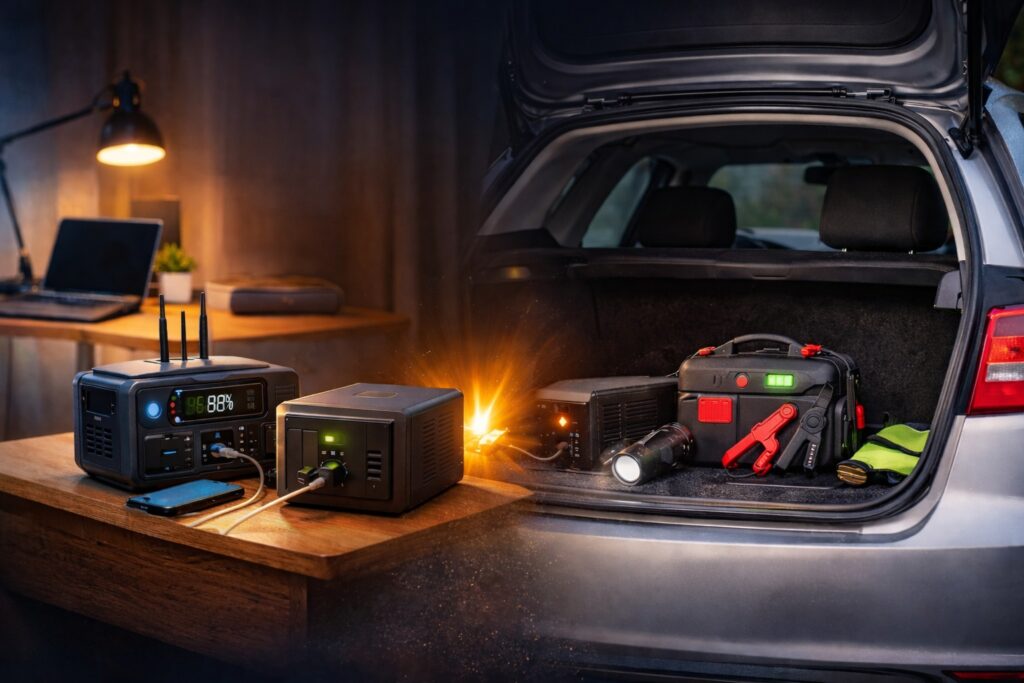
What Does “Emergency Power” Really Mean in the UK?
In the UK, emergency power is often misunderstood or oversimplified. Many households associate it purely with large backup batteries or assume it is only relevant during rare, extreme blackouts. In reality, emergency power is about preparedness for realistic, short-to-medium disruption scenarios that affect daily life far more often than total grid failure.
Emergency power covers any solution designed to keep essential devices running when mains electricity is unavailable — whether due to weather-related outages, grid maintenance, local faults, or temporary supply interruptions. The focus is not on replacing the national grid, but on maintaining connectivity, safety, and basic functionality during disruption.
Understanding what emergency power actually means in practical UK terms is the first step toward choosing the right solution rather than the largest one.
Emergency Power Solutions Explained for UK Homes
Emergency power solutions in the UK fall into several clearly defined categories, each designed for different scenarios and priorities.
At the most basic level, emergency power banks provide backup for phones, tablets, and small electronics. These are suitable for staying reachable but are limited in scope and runtime.
Moving up, portable emergency power stations offer AC power, higher capacity, and the ability to support routers, laptops, lighting, and multiple devices simultaneously. This category is where most UK households find the best balance between capability and practicality.
There is also vehicle-based emergency power, such as jump starters or car power solutions, which focus on mobility, roadside emergencies, and limited device charging rather than household backup.
The key distinction is that emergency power solutions are purpose-built for temporary disruption, not permanent replacement of mains electricity. They are designed to be portable, fast to deploy, and easy to use during unexpected situations.
Why Emergency Power Is About Scenarios, Not Capacity
One of the most common misconceptions is that emergency power should be chosen purely based on battery size. In reality, emergency power is about scenarios, not raw capacity figures.
A home user may need emergency power to keep a router, phone, and laptop running during a four-hour outage. A remote worker may prioritise stable internet and lighting. A driver may need emergency power for vehicle recovery rather than household use.
Each scenario places different demands on output type, runtime, portability, and recharge options. A higher-capacity unit is not automatically better if it introduces unnecessary cost, weight, or complexity.
Effective emergency power planning starts by asking:
- What devices must stay on?
- For how long?
- Where will the power be used — home, travel, or vehicle?
When emergency power is matched to realistic usage scenarios, even modest systems can deliver excellent real-world resilience.
Common Emergency Power Mistakes UK Households Make
Many UK households make avoidable mistakes when choosing emergency power, often due to unclear terminology or marketing-driven assumptions.
One common error is buying a battery that is far larger than needed, resulting in unnecessary expense and a system that is rarely used or properly maintained.
Another frequent mistake is having no clear usage plan. Without knowing which devices will be powered and in what order, even a capable emergency power system can feel inadequate during an outage.
A third issue is confusing emergency power with full backup power. Emergency power is designed for continuity and resilience, not for running energy-hungry appliances or entire homes indefinitely.
By understanding these pitfalls early, households can avoid overbuying, underusing, or misapplying emergency power solutions — and instead invest in systems that genuinely improve preparedness and peace of mind.

What Are Backup Batteries and How Do They Work?
Backup batteries are designed to provide automatic, short-term power continuity for specific devices when mains electricity fails. In the UK, they are most commonly used in the form of UPS systems (Uninterruptible Power Supplies), which activate instantly the moment a power cut occurs.
Unlike emergency power solutions, backup batteries operate in the background and are always connected between the device and the mains supply. Their primary role is not flexibility or portability, but seamless transition, ensuring that critical equipment stays online without interruption, data loss, or manual intervention.
Backup batteries are therefore best understood as passive continuity systems, rather than active emergency power sources.
Backup Batteries vs Emergency Power – Key Technical Differences
The most important technical difference between backup batteries and emergency power systems lies in how and when power is delivered.
Backup batteries rely on automatic switching. The moment a power cut is detected, the battery takes over instantly, often within milliseconds. This makes them ideal for devices that cannot tolerate downtime, such as routers, network switches, or desktop computers.
Emergency power systems, by contrast, are active solutions. They require manual connection and user decision-making but offer far greater flexibility, higher output, and longer runtime across multiple devices.
Another key distinction is scope of use. Backup batteries are usually designed to power one specific device or a small group of low-power devices for a limited time. Emergency power solutions are designed to support multiple devices, adapt to different scenarios, and provide usable power during broader household disruption.
In short:
- Backup batteries prioritise instant continuity
- Emergency power prioritises flexibility and real-world usability
Both serve important but very different roles in UK power resilience planning.
Typical Backup Battery Use Cases in the UK
In UK households, backup batteries are most commonly used in targeted, device-specific scenarios, rather than as whole-home solutions.
A very common use case is router and broadband backup. During short power cuts, a UPS can keep internet access online for 30–90 minutes, allowing continued communication or remote work.
Another frequent scenario is home office protection. Backup batteries are used to prevent sudden shutdowns of PCs, monitors, or network equipment, giving users time to save work and shut systems down safely.
Backup batteries are also widely used in smart home environments, where devices such as hubs, security systems, or automation controllers require constant power to function correctly.
However, these systems are not designed for flexibility. They cannot easily be moved, scaled, or used to power different devices during an outage — which is where emergency power solutions become the more practical choice for broader preparedness.

Emergency Power vs Backup Batteries – Direct Comparison
Choosing between emergency power and backup batteries is not about which solution is “better” in general, but which one fits a real-world UK power cut scenario. These two approaches solve different problems, operate in different ways, and deliver power with very different priorities.
Understanding how they compare in practice helps avoid overbuying, under-preparing, or choosing a solution that simply does not match how outages actually affect UK homes.
Emergency Power for Power Cuts, Travel and Mobility
Emergency power solutions are designed for active, flexible use during power outages and disruptions. They are not permanently wired into a single device but instead provide portable, on-demand power wherever it is needed.
In UK households, emergency power typically takes three main forms:
Portable power stations are the most versatile option. They can power routers, laptops, phones, lighting, radios, and other essential devices during outages, often for several hours. Their strength lies in flexibility — one unit can support multiple devices across different rooms as priorities change.
Emergency power banks focus on communication and mobility. While smaller in capacity, they are ideal for keeping phones, tablets, and laptops charged during short outages, travel disruptions, or when moving between locations.
Vehicle-based emergency power adds another layer of resilience. Jump starter power packs and vehicle-compatible power solutions allow users to stay powered when away from the home or when mains electricity is unavailable entirely.
This flexibility is why emergency power solutions are increasingly chosen for realistic UK outage scenarios, where power cuts are unpredictable, temporary, and affect different devices at different times.
➡️ You can see how these options compare in our full Emergency Power category, which covers home, travel, and vehicle-based solutions.
Backup Batteries for Always-On Devices
Backup batteries, most commonly in the form of UPS systems, are designed for a very specific role: instant, automatic continuity for devices that must not lose power even briefly.
UPS systems excel when:
- downtime is unacceptable
- devices must stay online without manual intervention
- power loss could cause data corruption or connection loss
This makes them ideal for routers, network switches, desktop PCs, NAS systems, and smart home hubs.
However, backup batteries come with clear limitations. They usually power only one device or a very small group of devices, have limited runtime, and are fixed in place. Once the battery is depleted, power is gone — there is no flexibility to reassign capacity to other devices.
In short, UPS systems win when instant switching and zero interruption matter more than runtime or mobility, but they are not designed to support broader household needs during longer or more disruptive outages.
Emergency Power vs Backup Batteries – Pros and Cons
Emergency power solutions offer adaptability and control. Users decide what to power, when to power it, and for how long. They can be moved between rooms, used during travel, shared across devices, and recharged in multiple ways. The trade-off is that they require manual connection and basic planning.
Backup batteries deliver hands-off protection. They switch on automatically, require no user action, and are excellent for preventing sudden shutdowns. The downside is their narrow scope — limited capacity, limited runtime, and almost no flexibility once deployed.
For most UK households, the choice is not either/or. Backup batteries work best for critical always-on devices, while emergency power solutions cover real-world disruption, where communication, lighting, mobility, and flexibility matter.
Understanding this distinction helps build a more realistic preparedness setup — one that matches how power cuts actually happen, not how we assume they might.
Which Emergency Power Solution Works Best for UK Homes in 2026?
Choosing the right emergency power solution in the UK is no longer just about battery size or brand name. In 2026, the most effective emergency power setups are those matched to real-life scenarios — how you live, where you live, and what you actually need to keep running when the mains power goes out.
UK households experience power cuts in very different ways. A short outage in a flat requires a completely different approach than a multi-hour disruption affecting a home office, or a vehicle-related emergency during travel. This is why the “best” emergency power solution is not universal — it depends on context, priorities, and usage patterns.
Below, we break down which types of emergency power work best for the most common UK home and lifestyle scenarios in 2026.
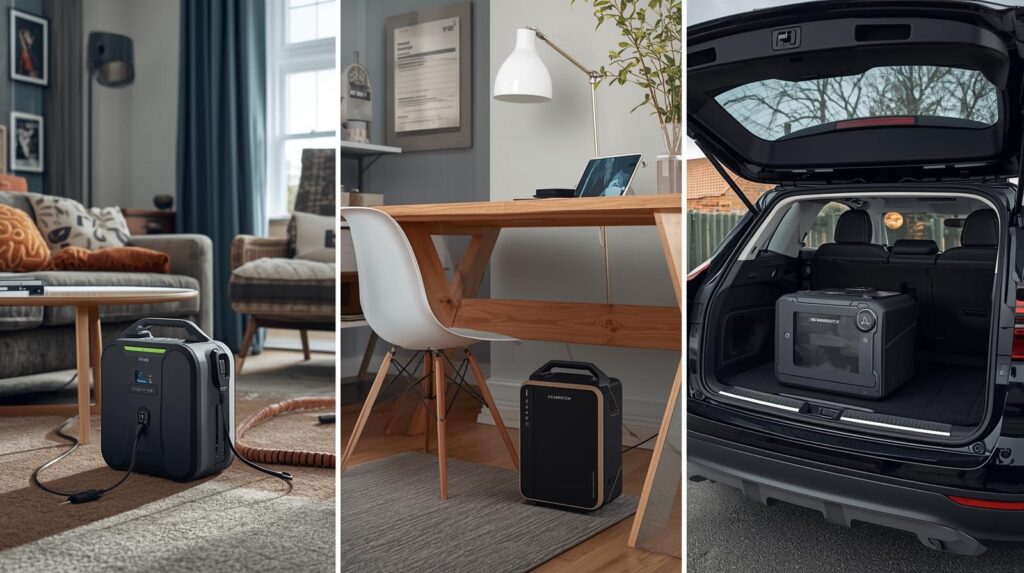
Emergency Power for Flats, Terraced Houses and Everyday UK Homes
For most flats and terraced houses in the UK, emergency power is primarily about maintaining connectivity, lighting, and basic comfort during short to medium-length power cuts. In these scenarios, compact and mid-sized emergency power stations or advanced emergency power banks offer the best balance between practicality and preparedness.
Typical needs in these homes include keeping the router online, charging phones and laptops, running LED lighting, and powering small electronics such as radios or medical accessories. Full whole-home backup systems are rarely necessary, while basic USB power banks are often too limited.
In 2026, the most effective emergency power solutions for everyday UK homes are:
- core emergency power banks with AC output for short outages
- profit-level emergency power stations for longer or repeated power cuts
- portable systems that can be moved between rooms as needed
If you want to compare which solutions fit different home setups, the full Emergency Power category breaks down options by capacity, use case, and real-world practicality in UK conditions.
Emergency Power for Home Offices and Remote Workers
Remote working has made emergency power far more critical for UK households than it was just a few years ago. For home offices, even a short power cut can mean lost work, broken meetings, or unstable internet connections.
In these scenarios, emergency power must prioritise:
- uninterrupted router and modem operation
- laptop and monitor power
- stable output for several devices at the same time
Core emergency power banks may keep a laptop charged, but they often struggle to support multiple devices simultaneously for longer periods. This is where higher-capacity emergency power stations become far more effective, offering longer runtime and reduced device rotation.
Many UK home office users now combine:
- a backup battery (UPS) for instant router switchover
- a portable emergency power station for extended runtime
This hybrid approach delivers both instant protection and long-lasting backup without the cost or complexity of fixed whole-home systems.
Emergency Power for Vehicles, Travel and Mobile Use
Not all emergency power scenarios happen at home. In the UK, vehicle-related breakdowns, travel disruptions, and outdoor emergencies are increasingly common reasons people invest in emergency power.
For these situations, portability and speed matter more than capacity. Vehicle-focused emergency power solutions, compact power banks, and jump-starter-style emergency power units are often the most appropriate choice. They are designed to:
- restart vehicle batteries
- charge phones and navigation devices
- provide basic power in roadside or travel emergencies
While these solutions are not designed for running household devices, they play a critical role in a complete emergency power strategy — especially for drivers, commuters, and frequent travellers.
In 2026, many UK households treat mobile emergency power as a separate but complementary layer alongside home-based emergency power solutions.
Common Emergency Power and Backup Battery Mistakes in the UK
Despite growing awareness around emergency power in the UK, many households still make costly and unnecessary mistakes when choosing backup solutions. These errors often lead to overspending, underperformance during real power cuts, or systems that simply do not work as expected when the mains power goes out.
Understanding these common pitfalls is just as important as choosing the right device. In many cases, poor emergency power experiences are not caused by bad products, but by mismatched expectations, incorrect assumptions, or a lack of planning around real-world use.
Below are the most common emergency power and backup battery mistakes UK households make in 2026 — and how to avoid them.
Buying Emergency Power Based on Capacity Alone
One of the biggest mistakes is assuming that bigger battery capacity automatically means better emergency power. Many users focus purely on watt-hours without considering how, where, and for how long the power will actually be used.
In reality:
- a large battery may sit unused for years
- higher capacity often means higher cost, size, and weight
- many households never need appliance-level backup
For typical UK power cuts, running a router, phones, lighting, and a laptop often requires far less capacity than people expect. Buying oversized emergency power systems can lead to wasted money and impractical setups that are difficult to store or deploy quickly.
Emergency power works best when it matches realistic usage scenarios, not worst-case assumptions that rarely occur.
Confusing Emergency Power with Backup Batteries (UPS)
Another frequent mistake is mixing up emergency power solutions with backup batteries such as UPS systems. While they both play an important role, they are designed for very different purposes.
Backup batteries:
- focus on instant switchover
- are optimised for always-on devices like routers
- usually offer limited runtime
Emergency power solutions:
- provide flexible, portable power
- support multiple devices
- are designed for longer outages
Using a UPS as a full emergency power solution often leads to disappointment, while relying only on emergency power without instant backup can cause short interruptions that disrupt work or connectivity. Many UK households benefit from combining both, rather than choosing one and expecting it to do everything.
Not Having a Clear Emergency Power Use Plan
Many people buy emergency power devices without a clear plan for what they will power first, for how long, or in what order. During an outage, this often leads to confusion, rushed decisions, and inefficient battery use.
Common issues include:
- trying to power too many devices at once
- forgetting to prioritise communication equipment
- running non-essential devices early and draining the battery
A simple emergency power plan — even a mental one — makes a significant difference. Knowing that the router, phones, and lighting come first allows households to stretch runtime and reduce stress during outages.
Overlooking Charging and Recharging Scenarios
Emergency power is only useful if it can be recharged reliably. A common oversight is focusing entirely on output and capacity, while ignoring how the device will be recharged after use.
In UK conditions, recharging considerations include:
- access to mains power between outages
- vehicle charging availability
- solar input during longer disruptions
Households that experience repeated power cuts often benefit from emergency power solutions with multiple charging options, rather than relying solely on mains recharging.
Assuming Emergency Power Is Only for Rare Events
Finally, many UK households treat emergency power as something that will “probably never be needed.” In reality, power cuts caused by weather, grid maintenance, and local faults are becoming more frequent, even if they are usually short.
Emergency power is increasingly used for:
- maintaining internet during brief outages
- protecting home office productivity
- supporting medical or accessibility devices
- reducing disruption rather than surviving disasters
Viewing emergency power as a practical resilience tool, rather than an extreme backup system, leads to better choices and more realistic setups.
Emergency Power and Backup Batteries – Frequently Asked Questions
Is emergency power worth having in the UK if power cuts are usually short?
Yes — and this is one of the most common misconceptions in the UK. While many power cuts last only minutes or a couple of hours, even short outages can cause significant disruption, especially when internet access, home working, or communication is affected.
Emergency power is not only about surviving long blackouts. In practice, UK households use emergency power to keep routers online, maintain mobile phone charging, power laptops during meetings, and avoid restarting smart home systems. Even short outages can interrupt work, security systems, or medical devices.
In 2026, emergency power is increasingly viewed as a convenience and resilience tool, not just an extreme backup solution. For many homes, a modest emergency power setup provides peace of mind and practical continuity without needing large or expensive systems.
What is the difference between emergency power and a backup battery (UPS)?
The key difference lies in how and when power is delivered.
A backup battery, such as a UPS, is designed for instant switchover. It activates automatically the moment mains power fails and is ideal for always-on devices like routers, modems, and network equipment. However, backup batteries usually offer limited runtime and are not designed to power multiple household devices.
Emergency power solutions, on the other hand, are active systems. They are switched on manually and provide flexible, portable power for a wide range of devices over longer periods. Emergency power stations and power banks can support phones, laptops, lighting, radios, and other electronics during outages.
In many UK homes, the most effective setup combines both — a backup battery for instant continuity and emergency power for extended runtime and flexibility.
How much emergency power capacity does a typical UK household actually need?
For most UK households, emergency power needs are far lower than expected. Running a router, charging phones, powering a laptop, and using LED lighting typically requires only modest capacity compared to running household appliances.
In practical terms:
- small emergency power banks are suitable for phone-only use
- core emergency power solutions cover routers, laptops, and lighting
- profit-level emergency power stations extend runtime and support more devices
Very few households genuinely need whole-home backup or appliance-level power. Choosing capacity based on realistic usage — rather than worst-case assumptions — leads to more efficient, affordable, and practical emergency power setups.
Can emergency power run household appliances like kettles or heaters?
In most cases, no — and this is an important limitation to understand. High-wattage appliances such as kettles, heaters, microwaves, and electric cookers require far more power than most portable emergency power solutions are designed to deliver.
Emergency power is best suited for:
- communication devices
- lighting
- laptops and productivity equipment
- networking and low-power electronics
Trying to run appliance-level devices often leads to rapid battery drain or overload protection activating. UK households that require appliance support typically need much larger, more expensive systems that fall outside the scope of portable emergency power.
Is emergency power safe to use indoors in UK homes?
Yes — modern emergency power solutions are designed for safe indoor use. Unlike petrol or diesel generators, emergency power stations and power banks produce no fumes, no noise beyond cooling fans, and no emissions.
Most quality emergency power devices include:
- overload protection
- temperature management
- short-circuit protection
- stable battery chemistry
This makes them suitable for use in living rooms, home offices, bedrooms, and shared spaces during power cuts, as long as manufacturer guidelines are followed.
Where can I compare different emergency power solutions for UK homes?
The easiest way to compare emergency power options is to view them by real-world use cases, rather than technical specs alone. Different households benefit from different solutions depending on outage length, device needs, and mobility.
To explore core, profit-level, and alternative emergency power solutions tailored to UK conditions, you can browse the full Emergency Power buying guide, where products are grouped by scenario, capacity, and practical home use rather than marketing claims.
dehumidifier can restore stable indoor humidity.