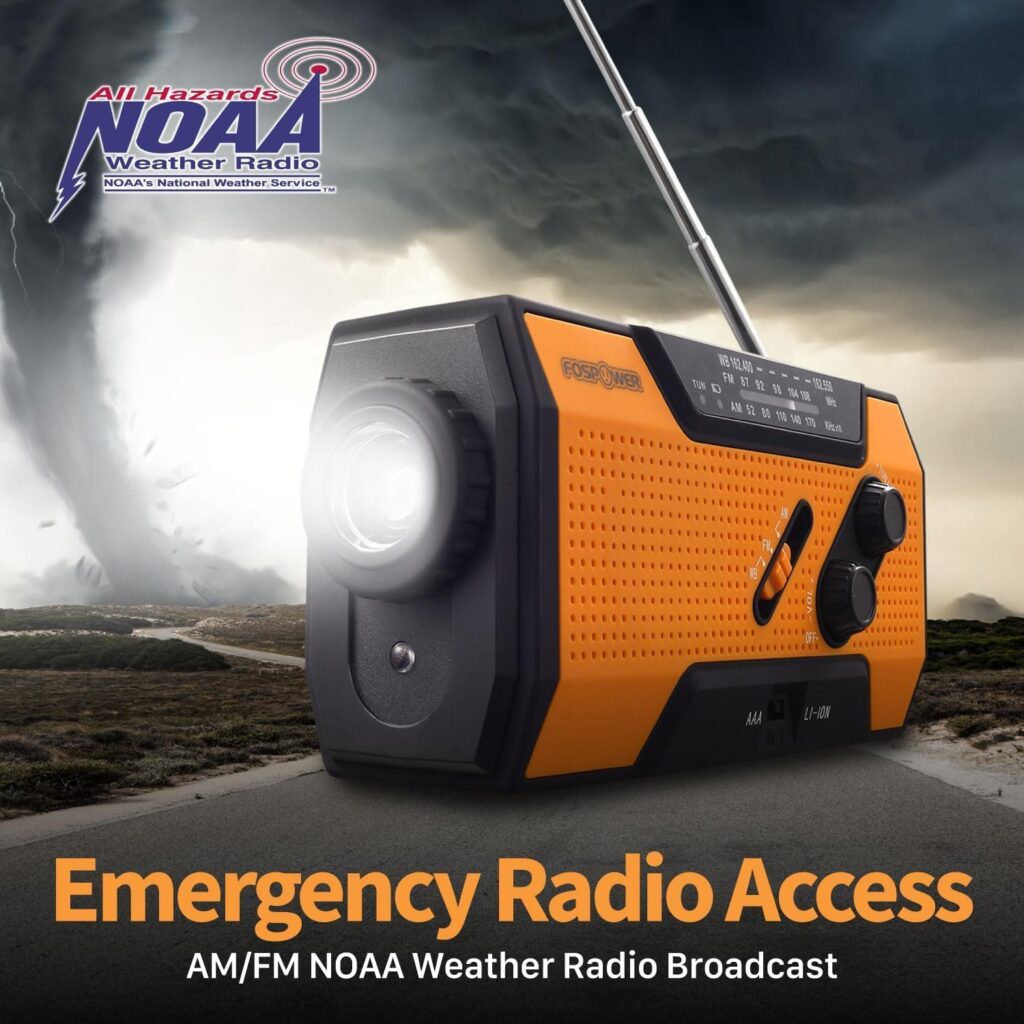
The FosPower NOAA Emergency Power Weather Radio A1 is designed for emergency preparedness in everyday UK situations, where access to information, communication, and basic power becomes critical during power cuts, severe weather, or unexpected disruptions. It sits firmly in the entry-level emergency power category, focusing on awareness and connectivity rather than high-capacity energy storage.
Instead of providing extended runtime for multiple devices, this model prioritises emergency alerts, radio communication, lighting, and basic device charging. With NOAA weather alerts, AM/FM radio, an integrated flashlight, and built-in power bank functionality, it supports staying informed and connected during outages when mains electricity or internet access may be unavailable.
This emergency power radio is aimed at users who want a compact, multi-function emergency device rather than a standalone battery solution. It is particularly suited for households preparing for storms and power cuts, as well as for travel, outdoor use, or keeping in an emergency kit. If your priority is receiving alerts, maintaining communication, and having basic backup power in one simple device, the FosPower A1 offers a practical and accessible entry point into emergency power preparedness.

Transparency note:
This review is part of our independent buying guide. Buying links and live price checks may be added in the future once they’re available.
Quick Overview
✔ Battery capacity: 7400mWh built-in power bank (suitable for basic emergency charging)
✔ Output options: USB output for phone and small device charging
✔ Radio functions: NOAA weather alerts + AM/FM radio
✔ Charging methods: USB charging, solar panel, hand crank, battery-powered
✔ Emergency features: SOS alarm, LED flashlight, weather alerts
✔ Typical use cases: power cuts, weather warnings, communication, lighting, emergency kits
Key Specifications and Features
The FosPower NOAA Emergency Power Weather Radio A1 is an entry-level emergency power and communication device designed for everyday UK emergency preparedness, where access to information and basic power is often more important than running multiple devices for long periods. It focuses on awareness, reliability, and multi-function use rather than energy capacity alone.
Instead of acting as a traditional battery backup, this model combines weather alerts, radio communication, lighting, and basic device charging into a single compact unit. The built-in power bank is suitable for topping up phones or small electronics during short outages, while the NOAA alert system and AM/FM radio help users stay informed when internet or mobile networks may be unreliable.
Multiple charging options add resilience in real-world emergency scenarios. In addition to USB charging, the hand crank and solar panel allow the device to function even when mains power is unavailable for extended periods. This makes it particularly useful during storms, severe weather events, or outdoor situations where electricity access is limited.
From a usability perspective, the compact design makes it easy to store in an emergency kit, take on trips, or keep in a vehicle. The integrated flashlight and SOS alarm provide additional safety and visibility during outages, further supporting its role as a preparedness-focused device rather than a standalone power solution.
Overall, the FosPower A1 is aimed at users who want a multi-purpose emergency power and communication tool. It offers dependable access to alerts, light, and basic charging without the size, cost, or complexity of larger emergency power systems, making it a practical entry point for emergency readiness.

Who Is the FosPower NOAA Emergency Power Weather Radio A1 Best For?
The FosPower NOAA Emergency Power Weather Radio A1 is best suited for users who prioritise emergency alerts, communication, and basic backup power rather than running multiple devices for extended periods. It is designed for everyday UK emergency scenarios such as power cuts, severe weather events, storms, or temporary loss of electricity and internet access.
This model works particularly well for users who want to stay informed and connected during disruptions. Typical use cases include receiving weather alerts, listening to AM/FM radio updates, using the built-in flashlight for visibility, and charging phones or small devices when mains power is unavailable. Its all-in-one design makes it a practical addition to a home emergency kit, travel bag, or vehicle.
It is a strong choice for households preparing for storms and outages, as well as for campers, travellers, and outdoor users who value self-powered emergency functionality. The multiple charging options — including hand crank and solar — make it especially suitable for users who want a device that remains usable even when electricity access is limited for longer periods.
Overall, the FosPower A1 is ideal for users looking for an entry-level emergency power and communication device that combines alerts, lighting, and basic charging in a compact, easy-to-use format. It offers a sensible starting point for emergency preparedness where awareness and connectivity matter as much as power availability.
Who Should Consider a Different Emergency Power Solution?
The FosPower NOAA Emergency Power Weather Radio A1 may not be the best choice for users who need extended backup power or want to run multiple devices continuously during long power outages. It is not designed to supply power to household appliances, routers for many hours, or several devices at the same time.
Users who experience frequent or prolonged power cuts and rely on backup power for laptops, home networking equipment, or higher-wattage electronics may find the built-in power bank capacity limiting. In these situations, larger emergency power units or portable power stations with higher energy storage are better suited to sustained use.
This model may also be less suitable for users looking to build a dedicated power-first emergency setup. While it offers basic charging capability, its primary focus is on alerts, communication, and visibility rather than acting as a standalone energy source. Those who prioritise runtime and output over information access should consider higher-capacity emergency power solutions.
For users whose main priorities are weather alerts, emergency information, lighting, and basic phone charging, however, the FosPower A1 remains a practical and accessible option. It is best viewed as a communication- and preparedness-focused device that complements larger emergency power solutions rather than replacing them.
Performance and Real-World Use
The FosPower NOAA Emergency Power Weather Radio A1 is designed for information access, visibility, and basic power support rather than continuous energy supply. In real-world UK conditions, it performs best during power cuts, storms, or severe weather events where staying informed and maintaining minimal device charging is more important than running appliances.
In everyday emergency scenarios, the radio function plays a central role. NOAA alerts and AM/FM broadcasts allow users to receive weather warnings and updates even when internet or mobile networks are unavailable. The built-in flashlight provides immediate visibility during blackouts, while the integrated power bank supports basic phone charging for essential communication.
As part of an emergency kit, the FosPower A1 proves particularly useful for maintaining awareness and readiness rather than powering multiple devices. Its ability to operate without mains electricity — using hand crank, solar input, or batteries — adds resilience in situations where recharging options are limited or unavailable.
For travel, outdoor use, or extended disruptions, the compact size and self-powered charging options make it easy to keep operational with minimal preparation. While charging speeds are modest, they are sufficient for maintaining critical functions over time rather than delivering fast, high-capacity power.
Overall, real-world performance aligns well with what users should expect from an entry-level emergency power and communication device. The FosPower A1 prioritises alerts, lighting, and basic charging, making it a practical tool for preparedness where information and visibility are just as important as power availability.

Day-to-Day Use and Everyday Convenience
One of the key strengths of the FosPower NOAA Emergency Power Weather Radio A1 is how easily it fits into everyday emergency preparedness without requiring technical setup or ongoing maintenance. Unlike larger emergency power devices, it is designed to be ready at all times, with simple controls and self-powered operation options.
For day-to-day readiness, the clearly labelled buttons and intuitive layout make it easy to switch between radio, flashlight, SOS alarm, and charging functions. There is no configuration required, which is especially important during stressful situations such as sudden power cuts or severe weather events when simplicity matters most.
Practical features such as multiple charging methods — including USB, solar, hand crank, and battery operation — allow the device to remain usable even when mains power is unavailable. This flexibility makes it suitable for long-term storage in an emergency kit, where it can be relied upon without regular charging cycles.
Despite offering several emergency-focused functions, the FosPower A1 remains compact and lightweight. It can be stored in a drawer, emergency bag, or vehicle without taking up significant space, and it is easy to carry when travelling or using outdoors.
Overall, everyday convenience is a strong advantage of this model. It provides a low-effort, always-ready emergency solution that combines alerts, lighting, and basic charging in one compact device, making it practical for users who want preparedness without complexity.
What the FosPower NOAA Emergency Power Weather Radio A1 Is Suitable For
The FosPower NOAA Emergency Power Weather Radio A1 is best viewed as an emergency communication and basic power support device rather than a solution for extended power supply or running multiple electronics. It performs most effectively in everyday UK scenarios where access to information, alerts, and minimal charging is the priority during temporary power disruptions.
In real-world use, it is well suited for situations such as:
receiving weather alerts and emergency broadcasts during storms or outages
staying informed via AM/FM radio when internet or mobile networks are unavailable
providing basic lighting using the built-in flashlight during blackouts
charging phones or small devices for essential communication
keeping a compact emergency kit ready for unexpected situations
In these settings, the FosPower A1 helps users remain informed, visible, and connected until normal services are restored. Its combination of radio alerts, lighting, and basic charging offers a practical alternative to single-purpose emergency devices.
Where its limitations become more noticeable is when users require extended power runtime, higher output, or the ability to power multiple devices simultaneously. It is not designed to replace dedicated emergency power banks or larger backup systems for sustained electricity needs.
If your situation requires longer charging capability, higher energy storage, or appliance-level power, a dedicated emergency power unit or portable power station will be a more suitable long-term solution.
Pros – What the FosPower NOAA Emergency Power Weather Radio A1 Does Well
Combines emergency radio, lighting, alerts, and basic power in one compact device
NOAA weather alerts help users stay informed during storms and severe weather
AM/FM radio provides access to news and updates when internet or mobile networks are unavailable
Built-in power bank supports basic phone and small device charging
Multiple charging options (USB, solar, hand crank, battery) add resilience during outages
Integrated flashlight and SOS alarm improve visibility and safety during blackouts
Simple, intuitive controls make it easy to use in stressful emergency situations
Compact and lightweight design fits easily into emergency kits, vehicles, or travel bags
Can operate without mains electricity, making it suitable for extended disruptions
Affordable entry-level option for emergency preparedness focused on awareness and communication
Cons – Where the FosPower NOAA Emergency Power Weather Radio A1 Has Limitations
Limited power bank capacity makes it unsuitable for extended device charging or long outages
Not designed to power household appliances or higher-wattage electronics
Charging speeds via hand crank or solar are slow and intended for emergency use only
Best suited for one device at a time, not simultaneous charging of multiple electronics
Radio and alert functions depend on signal availability, which may vary by location
Small integrated battery requires regular checking if stored long-term without use
Lacks advanced power features such as fast charging, expandable capacity, or energy management
Comparison with Similar Emergency Power Devices in the Entry Category
The FosPower NOAA Emergency Power Weather Radio A1 sits firmly in the entry-level emergency power and communication segment, offering a practical alternative to simple power banks and single-purpose emergency tools. This category is aimed at users who prioritise alerts, information access, and basic power support rather than extended runtime or appliance-level backup.
When compared to standard USB power banks, the difference in real-world usefulness becomes clear. Traditional power banks focus almost exclusively on charging phones and small electronics. The FosPower A1 adds NOAA weather alerts, AM/FM radio, a flashlight, and SOS alarm, making it far more suitable for emergency situations where staying informed and visible is as important as charging a device.
Compared to compact emergency power banks like the MARBERO 98Wh, the FosPower takes a different approach. Rather than providing higher output or AC power, it prioritises self-powered operation and communication. While power banks offer more charging capacity, they rely on pre-charging. The FosPower A1 can continue operating using hand crank, solar input, or batteries, which adds resilience during longer disruptions.
When set against larger emergency power units or portable power stations, the limitations are clear. Higher-capacity devices offer longer runtime and the ability to power multiple electronics, but they lack built-in alert systems and are heavier, more expensive, and less focused on communication. For users whose primary concern is awareness and preparedness rather than energy storage, that extra capacity may be unnecessary.
This positions the FosPower A1 as a communication-first entry-level emergency power device. It complements larger power solutions rather than replacing them, offering alerts, lighting, and basic charging in a compact format. For users who want reliable emergency information and minimal power support without investing in larger systems, it represents a practical and sensible choice.
Frequently Asked Questions – FosPower NOAA Emergency Power Weather Radio A1
Does the FosPower NOAA Emergency Power Weather Radio A1 work in the UK?
Yes, the FosPower A1 can be used in the UK. While NOAA weather alerts are primarily designed for the US alert system, the device’s AM/FM radio, flashlight, SOS alarm, and power bank functions work normally in UK conditions. Many UK users rely on it mainly for radio updates, lighting, and emergency charging rather than automated weather alerts alone.
Can this device charge my phone during a power cut?
Yes. The built-in power bank allows you to charge smartphones and small devices via USB during outages. Charging capacity is limited compared to dedicated power banks, but it is sufficient for emergency top-ups to maintain essential communication rather than full recharges.
How reliable are the solar and hand crank charging options?
Solar and hand crank charging are designed as emergency backup charging methods, not fast charging solutions. They are best used to maintain functionality over time — for example, keeping the radio, flashlight, or basic phone charging available during extended disruptions when mains power is unavailable.
Is this suitable for long power outages?
The FosPower A1 is suitable for staying informed and maintaining basic functionality during longer outages, but not for powering multiple devices continuously. Its strength lies in communication, alerts, and visibility rather than long-duration energy supply. It works best as a complement to larger emergency power solutions.
Does it need to be charged regularly if stored in an emergency kit?
For best readiness, it’s recommended to check and top up the internal battery periodically, especially if stored for long periods. However, the ability to operate via hand crank, solar input, or batteries makes it more forgiving than standard power banks if the internal battery is partially depleted.
Who should choose this over a standard emergency power bank?
This model is ideal for users who value alerts, radio access, lighting, and self-powered operation as much as charging capability. If your priority is awareness and preparedness during storms or outages — rather than running devices for long periods — the FosPower A1 is a more suitable choice than a simple power bank.
Final Verdict – Is the FosPower NOAA Emergency Power Weather Radio A1 Worth It?
The FosPower NOAA Emergency Power Weather Radio A1 is a practical entry-level emergency power and communication device designed for UK users who want to stay informed, powered, and prepared during short power cuts, severe weather events, or temporary loss of mains electricity. Rather than focusing on high-capacity energy storage, it prioritises information access, communication readiness, and basic device charging when reliability matters most.
Unlike standard power banks, the FosPower A1 combines NOAA emergency weather alerts, AM/FM radio reception, a built-in torch, SOS alarm, and multiple charging methods — including USB, solar, and hand crank power. This makes it especially valuable during emergencies where access to live weather updates and news is just as important as keeping a phone powered.
In real-world use, it is best suited for brief outages, storm preparedness, emergency kits, travel, and backup communication scenarios. The integrated power bank is ideal for topping up phones or small devices, while the radio and flashlight provide essential situational awareness and safety during blackouts or extreme weather conditions.
While it is not designed to run appliances or provide long-duration power, it performs exactly as an entry-level emergency preparedness device should. It focuses on self-powered operation, redundancy, and simplicity, making it suitable for households, renters, travellers, campers, and anyone building a basic emergency readiness setup.
For most users, the FosPower A1 offers excellent value by combining emergency power, weather alerts, and communication tools in a single compact unit. If you are choosing between simple power banks and more comprehensive emergency devices, exploring our full Emergency Power buying guide will help you compare options and decide which solution best matches your preparedness needs.