
Choosing the right portable power station for a camping fridge can be confusing because the answer depends on more than just the size of the battery. A fridge may have a low average power draw once it is running, but it can also use more power when the compressor starts, when the weather is warm, or when the lid is opened frequently.
For most camping fridge setups, the key things to check are the fridge wattage, battery capacity, expected runtime and how many other devices you want to power at the same time. A small power station may be enough for a short trip with a compact fridge, while a larger model may be needed for longer camping stays, caravan use or off-grid setups.
It is also important to think about real-world conditions. A fridge used in mild weather may use less energy than the same fridge in a hot tent, campervan or awning. Charging phones, lights, laptops or cooking equipment from the same power station will also reduce the available runtime.
This guide explains what size portable power station you may need for a camping fridge in the UK, how watts and battery capacity affect runtime, and when it makes sense to choose a smaller, mid-size or larger power station for camping use.
How Much Power Does a Camping Fridge Use?
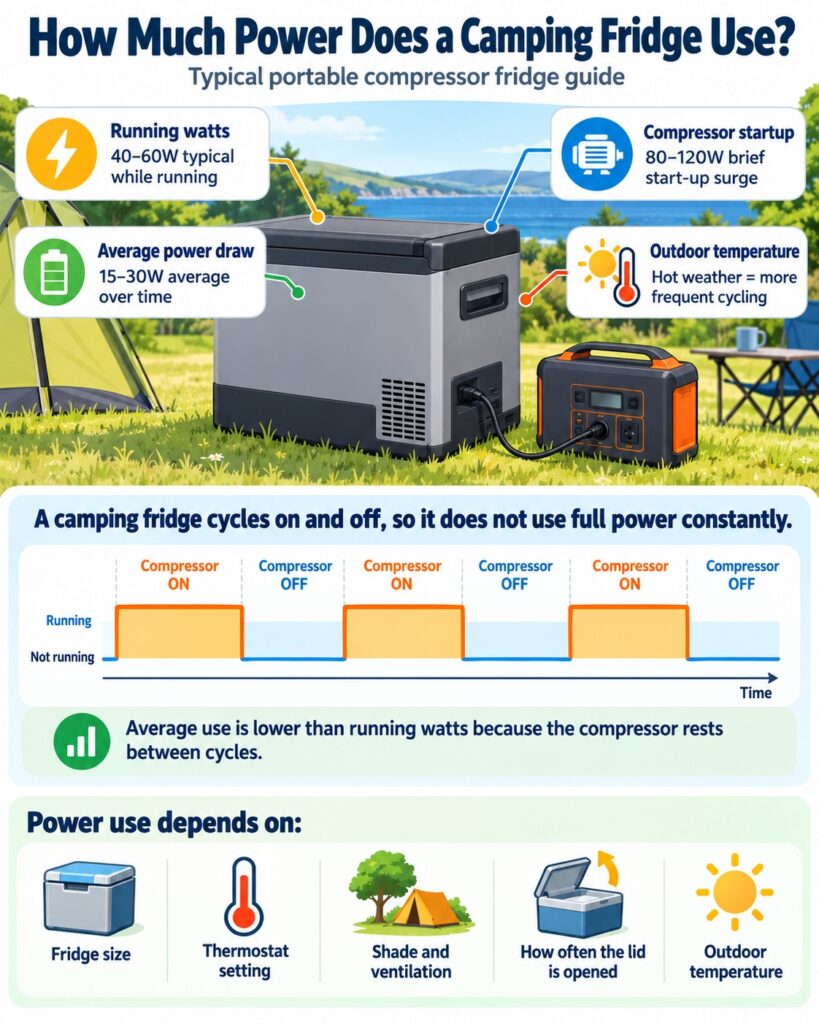
A camping fridge does not use power in exactly the same way as a simple device like a phone charger or LED light. Most compressor camping fridges cycle on and off during use. This means they may draw more power when the compressor starts, then use less power once the internal temperature is stable.
Many compact camping fridges may have a running power draw somewhere around 40W to 80W, depending on the model, temperature setting and outside conditions. However, the real daily energy use can vary because the fridge does not normally run at full power every minute of the day.
This is why it is important to look beyond the headline wattage. A fridge that draws 60W while running may not use 60W continuously for 24 hours. If the compressor only runs part of the time, the average power use may be lower. In warmer weather, or if the fridge is opened often, it may run more frequently and use more energy.
Startup demand can also matter. Some fridges briefly need more power when the compressor starts. A suitable portable power station should be able to handle both the fridge’s normal running wattage and any short startup surge.
For a wider explanation of battery size, watts and device runtime, our guide on what size portable power station you need explains how to match power station capacity to different devices and use cases.
How to Estimate Battery Capacity for a Camping Fridge
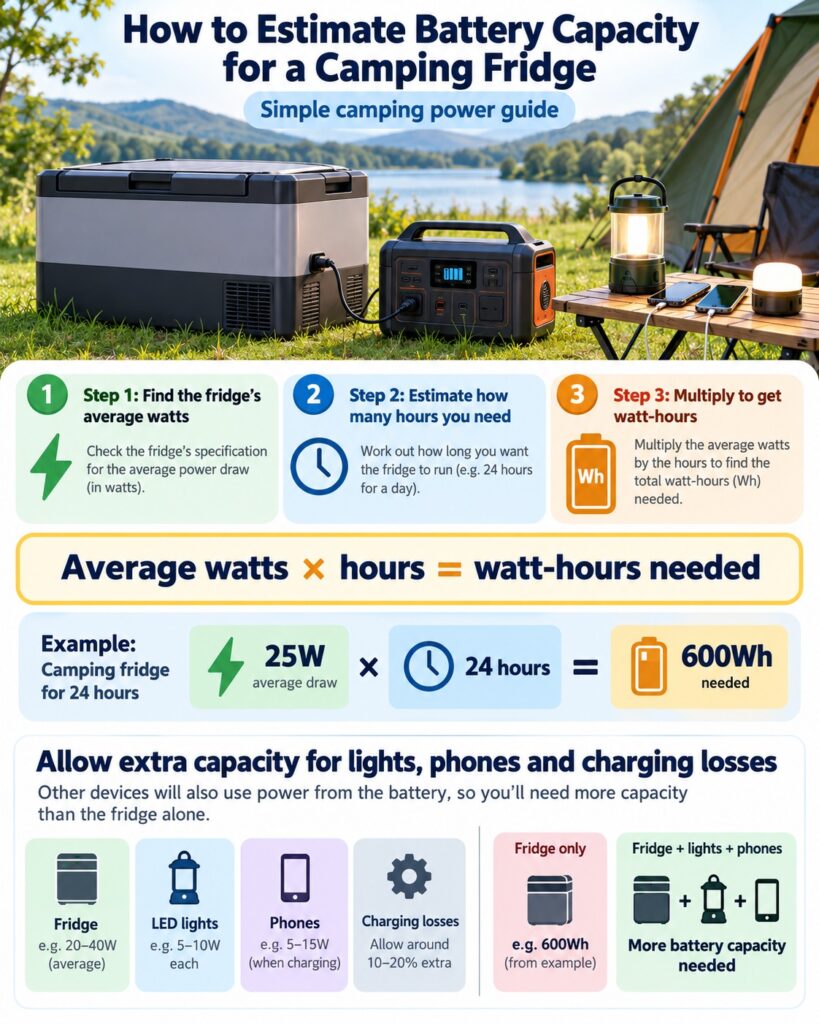
To choose the right portable power station for a camping fridge, you need to think about battery capacity as well as watts. Watts tell you how much power the fridge needs while running, while watt-hours tell you how much energy the power station can store.
A simple way to estimate runtime is to multiply the fridge’s average power use by the number of hours you want it to run. For example, if a camping fridge averages around 40W over time and you want it to run for 10 hours, it may need around 400Wh of usable energy.
However, portable power stations do not usually deliver every single watt-hour from the battery in real use. Some energy is lost through inverter efficiency, voltage conversion and normal operation. This means a 500Wh power station may not provide the full 500Wh to your fridge.
As a rough guide, a compact power station may suit short trips or small fridges, while a larger-capacity model is safer for overnight use, longer camping stays or warmer weather. If you are also powering phones, lights, laptops or other camping gear, you should leave extra capacity instead of sizing the battery only for the fridge.
For camping use, it is usually better to choose a little more capacity than the absolute minimum. This gives you more flexibility if the weather is warmer than expected, the fridge runs more often, or you need to power extra devices during the trip.
What Size Portable Power Station Do You Need for a Camping Fridge?
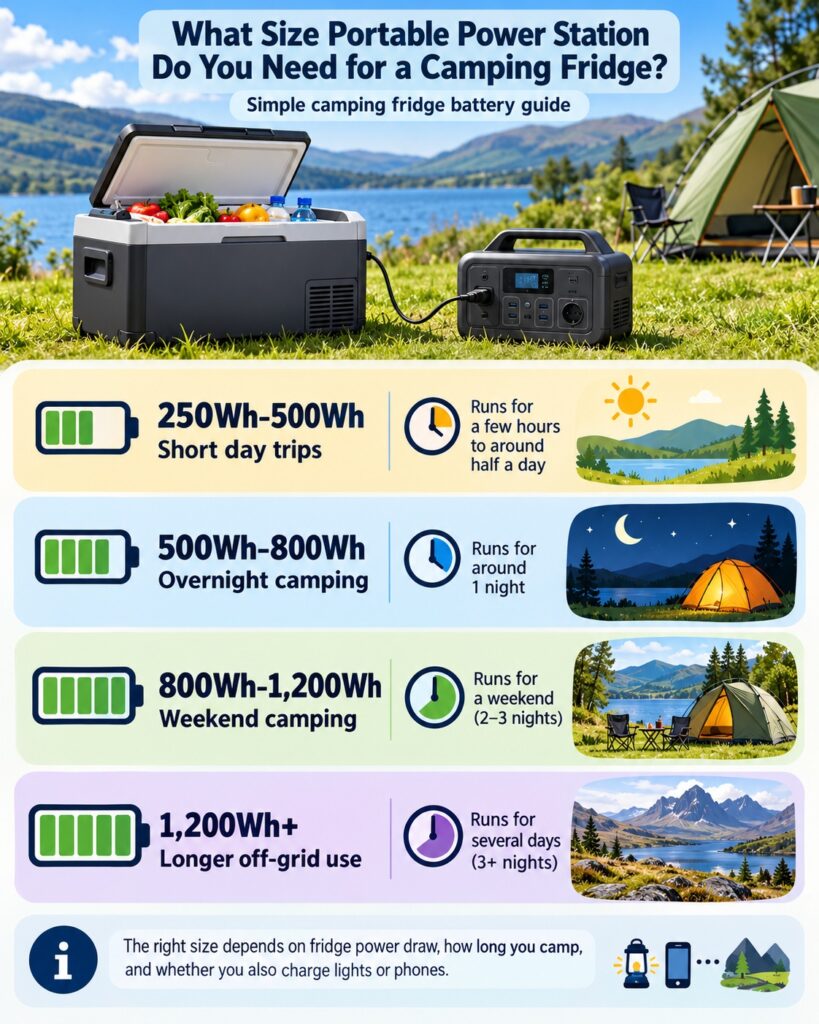
The right portable power station size depends on the fridge, trip length and how much spare capacity you want. There is no single size that fits every camping fridge, but you can use general capacity ranges to make a more practical choice.
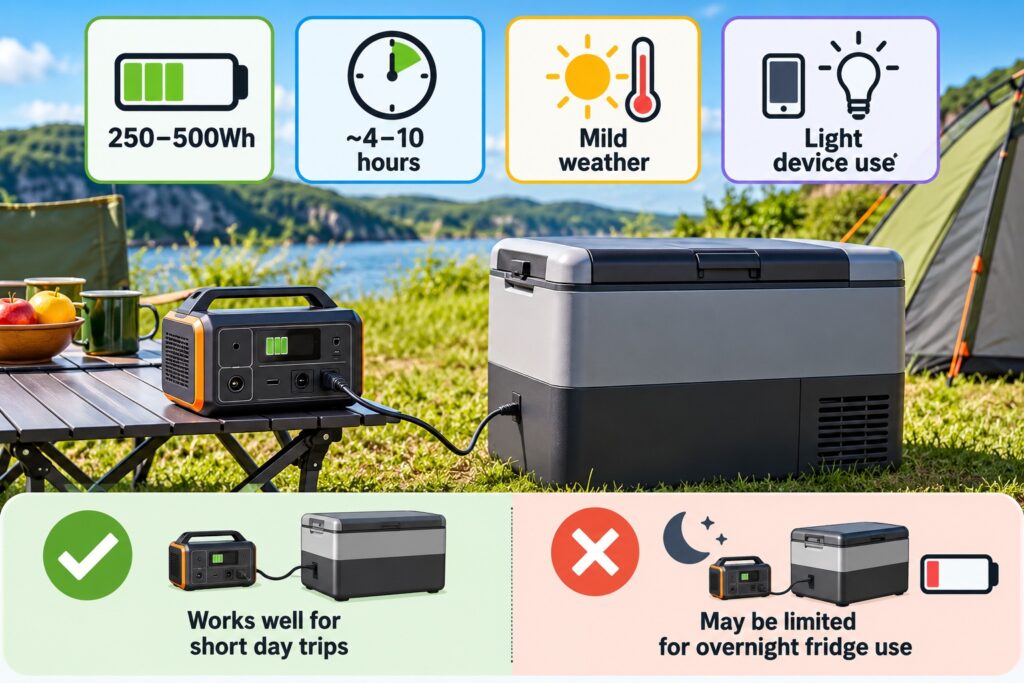
For a small camping fridge used for short daytime trips, a compact power station may be enough. This type of setup can work if the fridge is efficient, the weather is mild and you only need limited runtime. It is less suitable if you need overnight cooling or want to power several other devices.
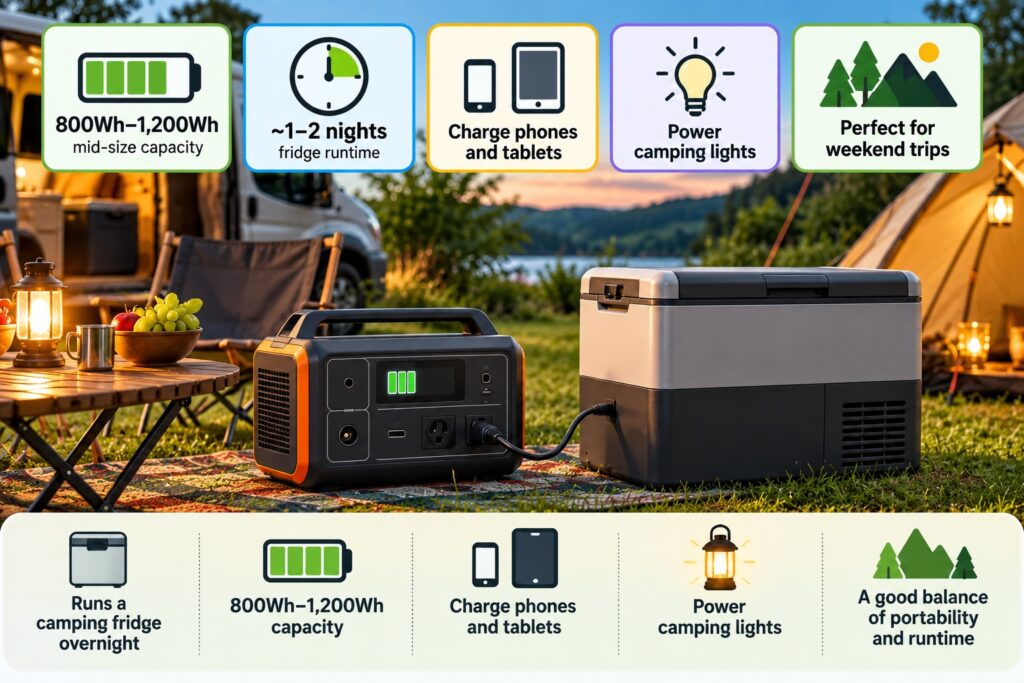
For most weekend camping trips, a mid-size portable power station is usually more practical. It gives more battery capacity, better flexibility and more room for extra devices such as phones, lights, tablets or a small fan. This can be a better balance for typical UK camping use.
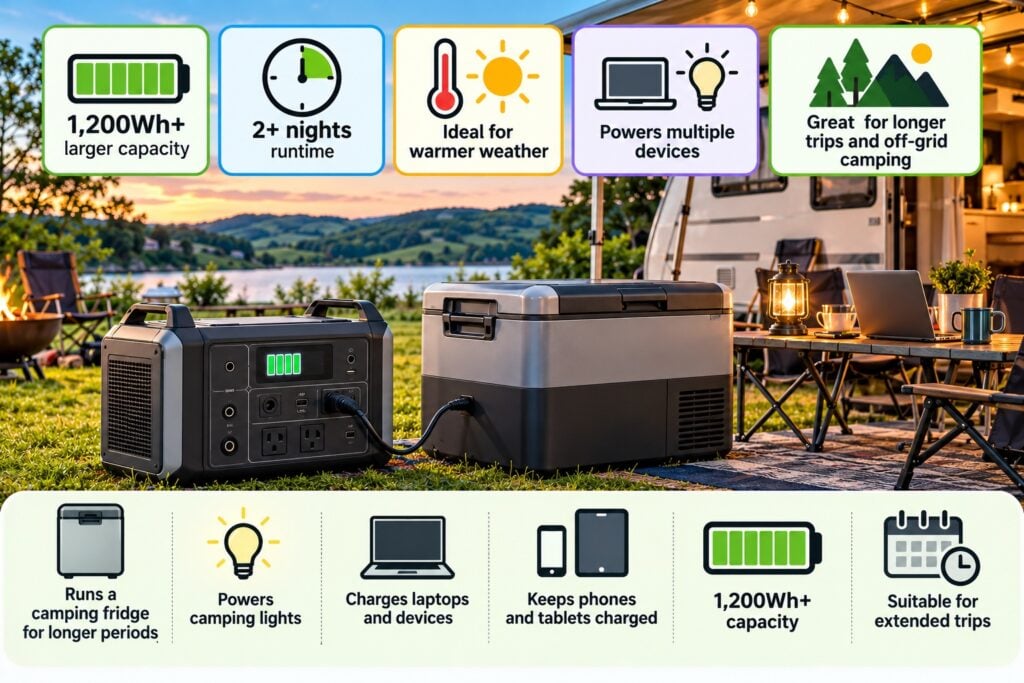
For longer trips, caravan use, off-grid camping or warmer conditions, a larger power station may be the safer choice. A bigger battery gives more runtime and reduces the risk of running out of power overnight or during a longer stay.
The table below gives a simple guide:
| Camping fridge use | Suggested power station size | Best for |
|---|---|---|
| Short day trip | 250Wh–500Wh | Small fridge, light use, mild weather |
| Overnight camping | 500Wh–800Wh | Compact fridge, phones, lights |
| Weekend camping | 800Wh–1,200Wh | Fridge plus extra devices |
| Longer off-grid use | 1,200Wh+ | Longer runtime, caravan use, backup power |
These ranges are only a guide. Always check your fridge’s wattage, estimated daily energy use and the usable capacity of the power station before relying on it for a full trip.
Is a Small Portable Power Station Enough for a Camping Fridge?
A small portable power station can be enough for a camping fridge, but only in limited situations. It may work for short trips, small efficient fridges, mild weather and light use where you do not need long overnight runtime.
The main limitation is battery capacity. A smaller power station may be able to run the fridge, but it may not keep it powered for as long as expected, especially if the fridge runs often in warm conditions. If you also charge phones, lights or other camping gear, the available runtime will drop further.
Small power stations are best suited to short daytime use, occasional cooling or backup support rather than longer off-grid trips. They are easier to carry, usually cheaper and more compact, but they leave less room for unexpected energy demand.
For example, a compact model such as the Jackery Explorer 240 V2 may suit light camping power needs, small devices and short-use scenarios, but buyers should check carefully whether its capacity is enough for their specific fridge and trip length.
If you want to power a camping fridge overnight, through a full weekend or alongside several other devices, a small power station may feel too limited. In that case, a mid-size or larger model is usually a safer choice.
Is a Mid-Size Portable Power Station Better for Camping Fridge Use?
A mid-size portable power station is often the better choice for camping fridge use because it gives more runtime and flexibility than a compact model without becoming too large or expensive. For many UK camping setups, this is the most practical middle ground.
This type of power station may suit overnight camping, weekend trips, small campervan setups and users who want to run a fridge while also charging phones, lights, tablets or other small devices. The extra capacity gives more breathing room if the fridge runs more often than expected.
A mid-size model can also be more reassuring in warmer weather. Camping fridges usually work harder when the outside temperature is higher, when the fridge is opened frequently or when it is placed inside a warm tent, awning or vehicle. Having more battery capacity helps reduce the risk of running out of power too early.
For example, a model such as the Bluetti EB3A may suit users who want more flexibility than a very small power station, while still keeping the setup relatively compact for camping and short off-grid use.
A mid-size power station is not always enough for long off-grid stays, large fridges or several high-power devices, but for many camping fridge setups it offers a sensible balance between portability, capacity and runtime.
When Do You Need a Larger Portable Power Station for a Camping Fridge?
A larger portable power station makes sense when you need longer runtime, more spare capacity or more reliable power for extended camping use. This is especially important if you are running a camping fridge overnight, over a full weekend, or during longer off-grid trips.
A bigger power station can also help if the fridge is larger, the weather is warm, or the fridge will be opened often. In these situations, the compressor may run more frequently, which increases energy use and reduces runtime from a smaller battery.
Larger models are also useful when the fridge is not the only device you want to power. If you also need to charge phones, lights, laptops, fans, cameras, cooking equipment or other camping gear, extra battery capacity gives you more flexibility and reduces the risk of running out of power.
For users who want a higher-capacity option for camping, caravan use, off-grid setups or home backup, the OUPES Mega 1 portable power station is an example of a larger model designed for longer runtime and more demanding use than compact camping power stations.
The trade-off is size, weight and cost. A larger power station is usually less convenient to carry and may be more than you need for short day trips. However, for longer camping fridge use, a bigger battery can provide much more peace of mind.
What Affects Camping Fridge Runtime in Real Use?
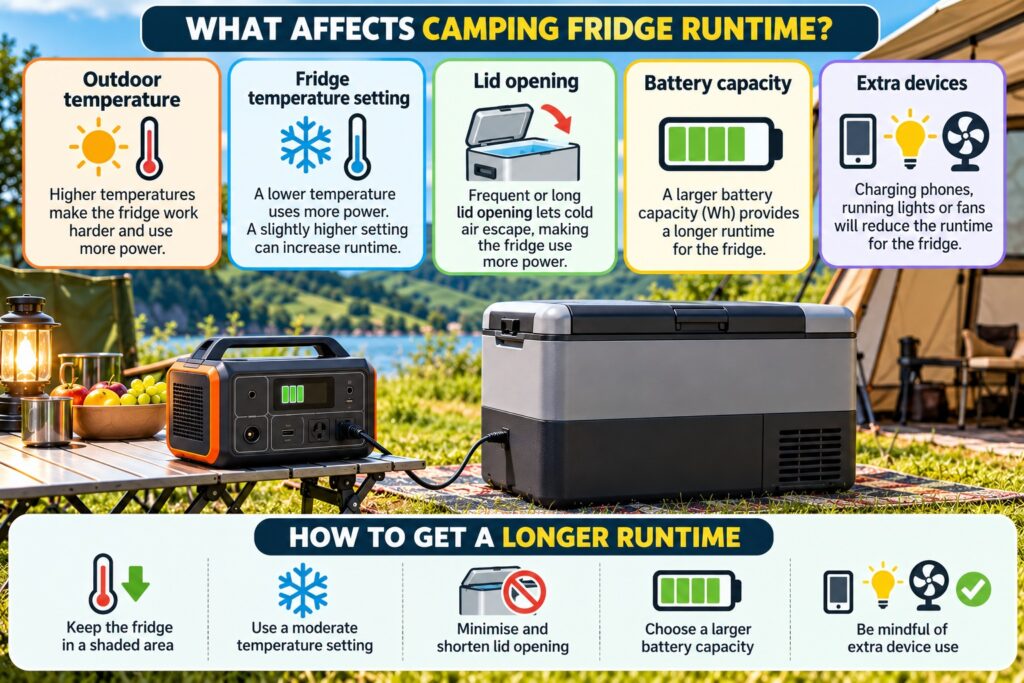
Camping fridge runtime depends on more than the battery size printed on the portable power station. The same fridge and power station can perform differently depending on weather, fridge settings, insulation, how often the lid is opened and whether other devices are connected at the same time.
Temperature is one of the biggest factors. A camping fridge used in mild UK weather may run less often than the same fridge used in a hot tent, awning or campervan. When the surrounding temperature is higher, the compressor usually needs to work harder to keep the fridge cool.
The fridge setting also matters. Keeping drinks cool is usually easier than maintaining a lower temperature for food over a long period. If you set the fridge very cold, it may cycle more often and use more energy.
How you pack and use the fridge can also affect runtime. A full fridge often holds temperature better than an almost empty one, but warm food or drinks added during the day can make the fridge work harder. Opening the lid frequently also lets warm air in and reduces efficiency.
Other devices connected to the same power station will reduce the available runtime. Phones, lights, laptops, fans and cooking devices all use part of the battery. For this reason, it is better to leave spare capacity rather than choosing a power station that only just covers the fridge on paper.
If you are comparing camping setups more broadly, our guide to the best portable power stations for camping in the UK looks at practical options for different outdoor power needs.
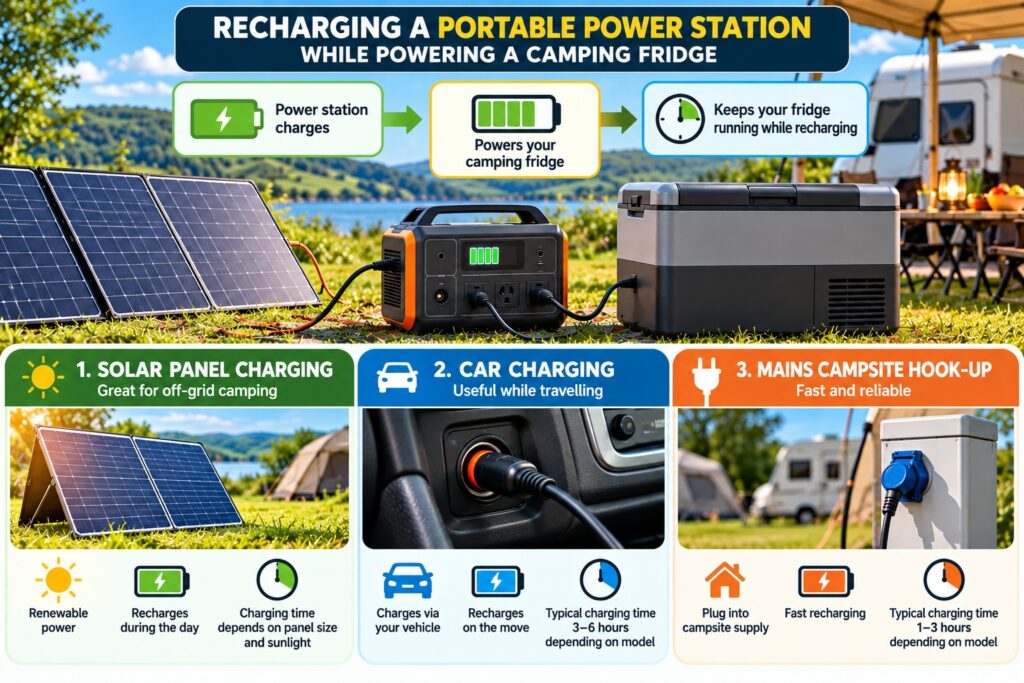
Can You Recharge a Portable Power Station While Running a Camping Fridge?
Some portable power stations can be recharged while powering devices, but it depends on the model and charging method. This can be useful for camping fridge use because it helps extend runtime during longer trips.
Solar charging is one of the most common options for camping. If the power station supports solar input, you may be able to top up the battery during the day while the fridge continues running. However, solar performance depends heavily on weather, panel size, sunlight angle and how long the panel is exposed to direct sun.
Car charging can also help during travel. If you are driving between campsites or using a campervan setup, charging from a vehicle may add useful battery capacity. However, car charging is usually slower than mains charging, so it may not fully refill a large power station quickly.
Mains charging is the most reliable option when available. If your campsite has electric hook-up, you may be able to recharge the power station overnight or before the next day’s use. This can make a smaller or mid-size power station more practical than it would be for fully off-grid camping.
The important point is not to rely on recharging unless you know the power station supports it properly and the charging speed is suitable for your trip. For longer fridge use, it is safer to choose enough battery capacity first, then treat solar, car or mains charging as extra support.
Common Mistakes When Choosing a Power Station for a Camping Fridge
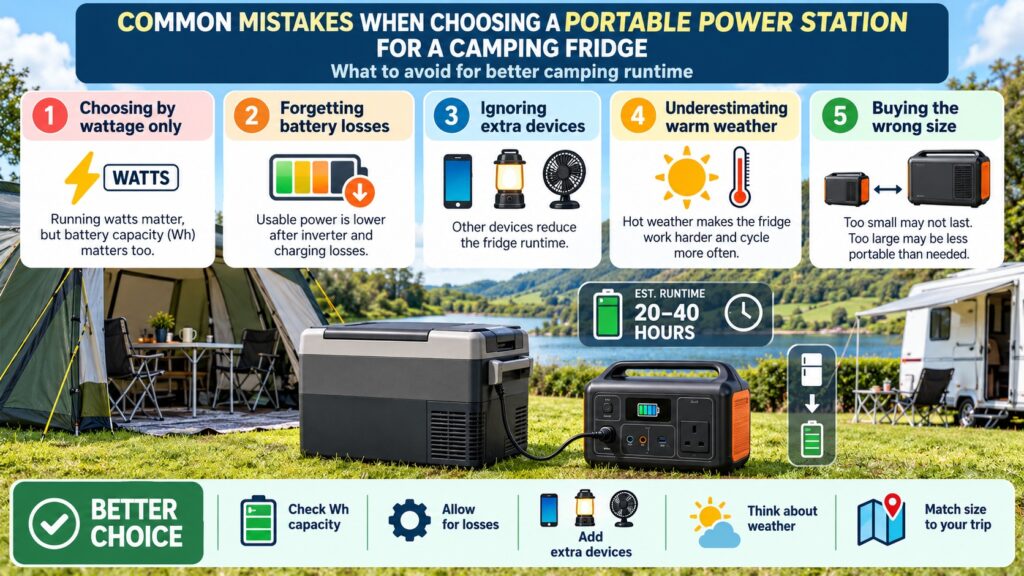
One of the biggest mistakes is choosing a portable power station based only on the fridge’s running wattage. A camping fridge may not use high power once running, but startup demand, warmer weather and longer runtime can all increase the real battery capacity needed.
Another common mistake is assuming the full battery capacity will be available in real use. A power station listed as 500Wh may not deliver the full 500Wh to your fridge because some energy is lost through conversion and normal operation. This is why choosing a little more capacity than the minimum calculation is usually safer.
Some buyers also forget about other devices. A fridge may be the main item, but camping setups often include phones, lights, tablets, fans, cameras or small appliances. Every extra device reduces the available runtime for the fridge.
Weather conditions are also easy to underestimate. A fridge running in a cool shaded area may use much less energy than one placed in a hot tent, awning or campervan. If you camp during warmer months, extra battery capacity can be very useful.
Finally, many people choose a power station that is either too small or much larger than needed. A small unit may run out too quickly, while a very large unit may be expensive and heavy for simple weekend camping. The best choice is usually the size that matches your fridge, trip length and realistic power needs.
Portable Power Station for Camping Fridge: Quick Buying Verdict
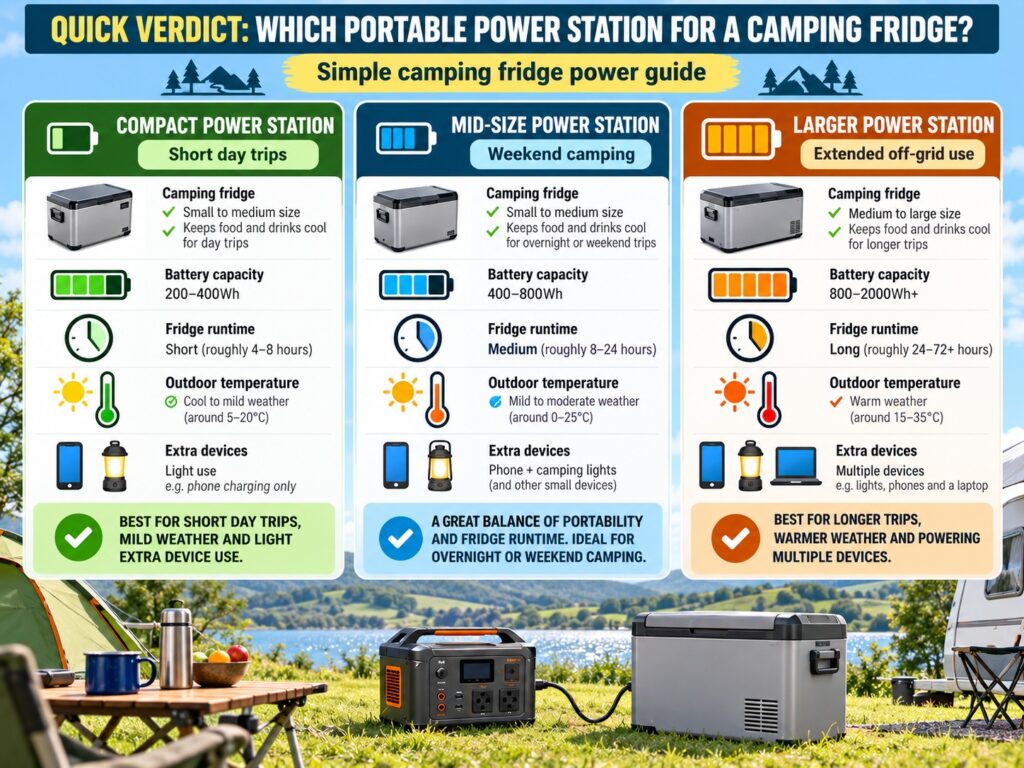
For short day trips with a small camping fridge, a compact portable power station may be enough, especially if the weather is mild and you are not powering many other devices. This type of setup is best for light use rather than overnight cooling.
For most UK camping trips, a mid-size portable power station is usually the safer and more practical choice. It gives more runtime, more flexibility and enough spare capacity for phones, lights, tablets or small camping accessories.
For weekend camping, caravan use, warmer weather or longer off-grid trips, a larger power station makes more sense. A bigger battery reduces the risk of the fridge running out of power overnight and gives you more confidence if the fridge works harder than expected.
The best size depends on your fridge’s wattage, average energy use, trip length, outdoor temperature and whether other devices will use the same battery. As a simple rule, choose more capacity than the minimum calculation rather than relying on a power station that only just covers the fridge on paper.
For many users, the most sensible choice is not the smallest or largest power station, but the one that gives enough runtime for the fridge with some spare capacity for real camping conditions.
Frequently Asked Questions About Portable Power Stations for Camping Fridges
What size portable power station do I need for a camping fridge?
The right size depends on the camping fridge’s wattage, average energy use and how long you need it to run. For short day trips, a smaller 250Wh–500Wh power station may be enough. For overnight or weekend camping, 500Wh–1,200Wh is usually more practical.
For longer off-grid trips, warmer weather or caravan use, a larger 1,200Wh+ power station may be a safer choice, especially if you also want to charge phones, lights, laptops or other camping equipment.
Can a portable power station run a camping fridge overnight?
Yes, a portable power station can run a camping fridge overnight if it has enough usable battery capacity and the fridge’s power demand is suitable. Compressor camping fridges are usually more efficient than basic cool boxes, but runtime still depends on temperature, fridge settings and how often the compressor runs.
For overnight use, it is usually safer to choose a mid-size or larger power station rather than relying on the smallest possible battery.
How many watts does a camping fridge use?
Many camping fridges may draw around 40W to 80W while running, but this varies by model, temperature setting and outdoor conditions. The fridge may also need a short burst of extra power when the compressor starts.
The important figure is not only the running wattage, but the average energy use over time. A fridge does not usually run at full power every minute, but it may run more often in warm weather.
Is 500Wh enough for a camping fridge?
A 500Wh portable power station may be enough for a small efficient camping fridge during short trips or limited overnight use, especially in mild weather. However, it may feel limited if the fridge runs often, the weather is warm or you also charge other devices.
For weekend camping or more reliable overnight use, many buyers may prefer a larger capacity so there is more spare battery available.
Is 1,000Wh enough for a camping fridge?
A 1,000Wh portable power station can be a practical size for many camping fridge setups. It gives more runtime than a compact model and leaves more capacity for extra devices such as phones, lights, tablets or small fans.
It may still not be enough for every situation, especially for larger fridges, long off-grid trips or heavy use, but it is often a sensible middle ground for weekend camping.
Can I use solar panels to keep a camping fridge running?
Solar panels can help extend runtime if your portable power station supports solar charging. This can be useful during longer camping trips because the battery can be topped up during the day while the fridge continues to run.
However, solar charging depends on sunlight, panel size, weather and charging speed. It should be treated as useful support rather than a guaranteed replacement for choosing enough battery capacity.
Should I choose a small or large power station for camping?
Choose a small power station if you only need light camping power, short fridge use and occasional charging for small devices. Choose a larger power station if you need overnight fridge use, weekend camping, caravan power, off-grid trips or support for multiple devices.
The best option is usually the size that gives enough fridge runtime with some spare capacity, without becoming too heavy or expensive for your type of camping.
Can a portable power station run a fridge and other devices at the same time?
Yes, many portable power stations can run a camping fridge and charge other devices at the same time, as long as the total power demand does not exceed the output limit and the battery capacity is large enough.
Phones, lights and tablets usually use much less power than a fridge, but they still reduce the available runtime. If you plan to power several devices, choose more capacity than the fridge alone requires.
Final Verdict: What Size Portable Power Station Do You Need for a Camping Fridge?
The best portable power station size for a camping fridge depends on how long you need the fridge to run, how efficient the fridge is and whether you are powering other devices at the same time. A small power station may work for short day trips, but it can feel limited for overnight or weekend camping.
For most UK camping fridge setups, a mid-size portable power station is usually the most practical starting point. It gives more battery capacity, better runtime and enough flexibility for phones, lights and small camping accessories without becoming too large for normal camping use.
A larger power station is a better choice for longer trips, caravan use, warmer weather, larger fridges or off-grid setups where running out of power would be a problem. It costs more and takes up more space, but it gives much more confidence for extended use.
The safest approach is to check your camping fridge’s wattage, estimate the average energy use, decide how many hours of runtime you need and then choose a power station with spare capacity. In real camping conditions, it is usually better to have more capacity than to rely on a battery that only just covers the fridge on paper.