
Choosing the right dehumidifier in the UK is not as straightforward as picking the biggest or cheapest model available. British homes face a unique combination of challenges: cool temperatures, high outdoor humidity, limited ventilation, and everyday moisture from cooking, showering, and indoor laundry drying.
As a result, many buyers end up with a dehumidifier that looks good on paper but performs poorly in real-world use. Common mistakes include choosing the wrong capacity, overlooking energy use in cold conditions, or selecting a unit that simply does not match how the room is actually used.
This guide explains how to choose the right dehumidifier for UK homes based on practical factors that matter: capacity, energy consumption, room temperature, and real-life performance. Instead of marketing claims and lab figures, we focus on how dehumidifiers behave in bedrooms, flats, family homes, and unheated spaces across the UK.
By the end of this article, you will understand exactly what to look for, what to avoid, and how to choose a dehumidifier that delivers reliable moisture control without unnecessary running costs or disappointment.
How to Choose the Right Dehumidifier for UK Homes
Choosing the right dehumidifier for a UK home starts with understanding why moisture builds up in the first place. Unlike warmer climates, UK properties often struggle to release humidity naturally due to cooler temperatures and consistently high outdoor moisture levels. This means that opening windows alone is rarely enough to solve condensation or damp problems.
The most effective dehumidifier is not defined by brand or headline features, but by how well it matches your room conditions, usage patterns, and moisture load. Factors such as room temperature, ventilation, insulation quality, and whether laundry is dried indoors all play a critical role in determining which type of unit will perform well.
Many buyers focus only on price or capacity, but this often leads to poor results. A correctly chosen dehumidifier should:
- Run efficiently without needing to operate constantly
- Maintain stable humidity levels rather than reacting too slowly
- Match the temperature and size of the space it is used in
Understanding these fundamentals makes the difference between a dehumidifier that quietly solves the problem and one that runs continuously without noticeable improvement.
Why “Litres Per Day” Ratings Are Often Misleading in the UK
The litres-per-day figure is measured in laboratory conditions that do not reflect how UK homes actually behave. These tests are usually carried out at high temperatures (around 30°C) and very high humidity levels, which dramatically increase how much moisture can be extracted in a short time.
In real UK homes, especially outside summer, rooms are often cooler, less ventilated, and used throughout the day. As a result, a dehumidifier advertised as removing 12L or even 20L per day may extract significantly less moisture under normal conditions. This does not mean the unit is faulty — it simply means the rating is theoretical rather than practical.
This is why relying only on litres per day often leads to disappointment. Buyers expect fast results, but the room conditions limit how much moisture can realistically be removed. Understanding this helps set realistic expectations and prevents choosing a unit that is either underpowered or unnecessarily large.
Matching Dehumidifier Capacity to Room Use, Not Just Size
Room size alone is not enough to determine the right dehumidifier capacity. How the room is used plays a much bigger role in real-world performance.
For example, a small bathroom used daily can generate more moisture than a larger living room. A utility room drying laundry can require a higher-capacity unit than a bedroom twice its size. Likewise, a cold spare room may hold onto moisture far longer than a warm, well-used space.
A well-matched dehumidifier is one that:
- Can keep up with daily moisture input
- Runs steadily rather than constantly switching on and off
- Maintains stable humidity instead of chasing spikes
Choosing capacity based on real use — showers, cooking, laundry, temperature — leads to better results, lower running costs, and longer device lifespan than simply buying the biggest model available.
If energy use is one of your main concerns, our guide to choosing the most energy efficient dehumidifier size explains how mini, 10L, 12L and 20L models compare for running costs, room size and everyday moisture control.
Energy Use and Running Costs of Dehumidifiers in the UK
Understanding dehumidifier energy use in the UK is essential for choosing a model that not only controls moisture effectively but also remains affordable to run throughout the year. While many products are marketed as “low energy”, real-world running costs depend far more on how long the dehumidifier runs, where it is used, and which technology it uses than on headline wattage figures alone.
In typical UK homes — where temperatures are often moderate to cool and humidity is persistent rather than occasional — energy efficiency should be assessed based on practical usage, not marketing labels.
Compressor vs Desiccant – Energy Use in Real Homes
Compressor and desiccant dehumidifiers consume energy in very different ways, and their efficiency depends heavily on room temperature.
Compressor dehumidifiers are generally more energy-efficient in warm, lived-in rooms such as bedrooms, lounges, and open-plan living areas. When temperatures stay above around 15–18°C, they extract moisture efficiently and often cycle on and off once target humidity is reached, keeping overall electricity use low.
Desiccant dehumidifiers, by contrast, maintain consistent performance in cold or unheated spaces such as garages, basements, spare rooms, or utility areas. While they typically have higher wattage per hour, they remove moisture more reliably in these environments, which can reduce total running time.
In real UK conditions, energy efficiency is not about which type uses fewer watts on paper — it is about which type removes moisture fast enough in the specific room so it does not need to run continuously.
What “Low Energy” Really Means on UK Electricity Bills
A common misconception is that a lower wattage dehumidifier is always cheaper to run. In reality, running hours matter far more than wattage.
For example:
- A 300W dehumidifier running for 10 hours a day costs more than
- A 600W dehumidifier running efficiently for 3–4 hours
Many UK households end up with higher bills because an underpowered or unsuitable dehumidifier runs almost constantly without ever stabilising humidity levels.
True “low energy” performance comes from:
- Correctly matching the dehumidifier type to room temperature
- Choosing adequate capacity for the moisture load
- Allowing the unit to reach target humidity and cycle off
When selected properly, a dehumidifier becomes a controlled, predictable energy cost rather than a device that runs endlessly with limited results.
Choosing the Right Dehumidifier for Real-World Use
Choosing the best dehumidifier for UK homes is less about chasing the biggest capacity or the lowest wattage and more about matching the unit to how your home is actually used day to day. UK properties vary widely in insulation, ventilation, and temperature, which means the “right” dehumidifier often depends on the specific room rather than the size of the property as a whole.
Below are the most common real-world scenarios where dehumidifiers are used in the UK, and what typically works best in each case.
Bedrooms
Bedrooms are one of the most common places where excess humidity becomes noticeable, especially overnight. Breathing, limited ventilation, and cooler temperatures can lead to window condensation and a damp feeling in the morning.
For bedrooms, quieter operation and stable humidity control are more important than maximum extraction. Mid-range compressor dehumidifiers work well in heated bedrooms, while desiccant models are often better suited to colder spare rooms. The goal here is comfort, not aggressive moisture removal.
Flats and Apartments
Flats often suffer from poor airflow, limited window opening, and moisture migrating between rooms. Cooking, showering, and indoor laundry can quickly raise humidity levels across the entire space.
In these environments, a dehumidifier with sufficient capacity to handle daily moisture is essential. Undersized units tend to run constantly without ever stabilising humidity, while correctly sized models help maintain consistent air quality throughout the flat with predictable running costs.
Indoor Laundry Drying
Drying clothes indoors is one of the biggest sources of excess moisture in UK homes. Without active moisture removal, humidity can linger for hours and contribute to condensation and mould growth.
For laundry drying, extraction speed matters more than silence. Compressor dehumidifiers perform well in warm rooms, while desiccant models are particularly effective in winter or unheated spaces. Choosing a unit designed to handle laundry loads dramatically reduces drying time and prevents moisture spreading to the rest of the home.
Cold or Unheated Rooms
Garages, basements, utility rooms, and spare rooms often remain cold year-round. In these spaces, many standard dehumidifiers struggle or become inefficient.
Desiccant dehumidifiers are generally the most reliable option for cold environments, as they maintain consistent performance regardless of temperature. This makes them ideal for long-term damp prevention in rooms that are rarely heated.
If you want to compare which types and capacities work best for each of these scenarios, our Dehumidifiers buying guide breaks down dehumidifiers for UK homes based on room type, temperature, and real-world usage rather than marketing claims.
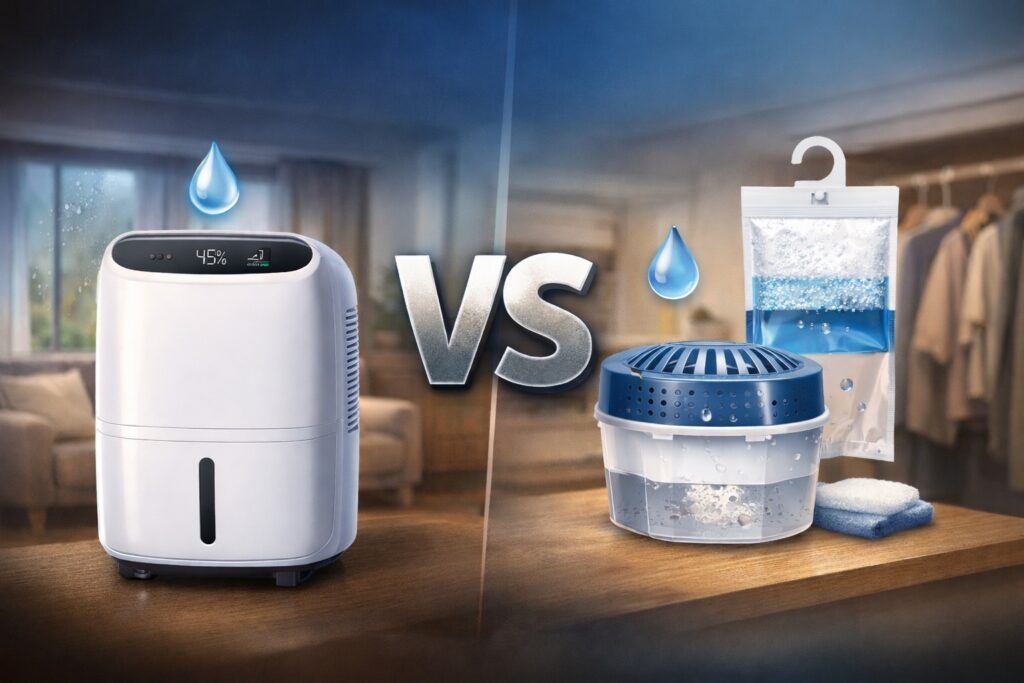
When to Use a Moisture Absorber Instead of a Dehumidifier
While dehumidifiers are the most effective solution for controlling indoor humidity in UK homes, there are still limited situations where a moisture absorber can make sense. Understanding the difference between these two approaches helps avoid overbuying — or choosing a product that simply won’t solve the problem.
Moisture absorbers work best in very small, enclosed spaces where humidity builds up slowly and there is no ongoing moisture source. Typical examples include wardrobes, cupboards, storage boxes, or caravans in storage. In these cases, passive absorption can help reduce musty smells and light condensation without electricity or setup.
However, once humidity becomes a regular, room-wide issue, moisture absorbers quickly reach their limits. They cannot circulate air, respond to humidity spikes, or stabilise moisture levels over time. This is where many UK households realise that a dehumidifier is not just more powerful, but fundamentally a different type of solution.
If you want a deeper, side-by-side explanation of how these two options compare in real UK conditions — including performance, costs, and long-term effectiveness — see our detailed guide dehumidifiers vs moisture absorbers which breaks down when each option actually works.
Dehumidifier FAQ – UK Buyers
What size dehumidifier do I need for a UK bedroom?
For a typical UK bedroom, the right dehumidifier size depends more on how the room is used than its exact square metre size. A standard bedroom with everyday use, occasional window condensation, and normal ventilation usually works well with a mid-range dehumidifier rated around 8–12 litres per day.
If the bedroom is colder, poorly ventilated, or regularly affected by condensation on windows, a slightly higher-capacity unit may deliver more stable results. In contrast, mini dehumidifiers are generally too weak to control humidity in a bedroom used daily, especially during autumn and winter.
As a rule, UK bedrooms benefit most from a dehumidifier that can run steadily without needing to operate at maximum output all the time.
Are desiccant dehumidifiers cheaper to run in winter?
In cold UK conditions, desiccant dehumidifiers can be more cost-effective in practice, even if their stated wattage is higher. This is because they maintain consistent moisture removal at low temperatures, whereas compressor dehumidifiers lose efficiency as rooms drop below around 15°C.
In unheated bedrooms, garages, basements, or spare rooms during winter, a desiccant model often removes moisture faster and reaches target humidity sooner. This can reduce total run time, which matters more than hourly power draw when calculating real electricity costs.
In heated living areas, however, compressor dehumidifiers usually remain the cheaper option to run.
How many hours a day should a dehumidifier run?
There is no single correct number of hours, as it depends on humidity levels, room size, and how the space is used. In most UK homes, a dehumidifier runs longest when first installed, as it removes built-up moisture from walls, furniture, and air.
After this initial phase, many households find that running a dehumidifier for 6–10 hours per day is enough to maintain comfortable humidity levels. Models with humidity sensors can cycle on and off automatically, which is often more efficient than manual timers.
For laundry drying or high-moisture rooms, longer daily use may be required, especially in winter.
Is a bigger dehumidifier always better?
Bigger is not always better. An oversized dehumidifier can remove moisture too quickly in smaller rooms, causing frequent on-off cycling. This can increase noise, reduce efficiency, and create unnecessary wear on the unit.
The most effective dehumidifier is one that matches the room’s moisture load, not just its size. A mid-capacity model running steadily often performs better than a high-capacity unit running intermittently.
Higher-capacity dehumidifiers are best reserved for homes with visible damp, multiple affected rooms, or frequent indoor laundry drying.
Can a dehumidifier replace ventilation?
A dehumidifier does not replace proper ventilation, but it significantly improves indoor humidity control when ventilation is limited, which is common in UK homes during colder months.
Ventilation helps remove moisture at the source, while a dehumidifier controls residual humidity that remains trapped indoors. Used together, they are far more effective than either solution alone.
In practice, many UK households rely on dehumidifiers because opening windows is not always practical or effective due to cold weather and high outdoor humidity.
Are mini dehumidifiers worth it in UK homes?
Mini dehumidifiers can be useful, but only in very small, enclosed spaces such as wardrobes, cupboards, or storage areas. They are not designed to control humidity in lived-in rooms like bedrooms, lounges, or bathrooms.
In real UK home conditions, mini dehumidifiers often collect some water but fail to reduce overall humidity levels. This leads to disappointment when condensation and damp remain unchanged.
For most rooms used daily, a properly sized electric dehumidifier offers far better long-term results and value.
Final Verdict – How to Choose the Right Dehumidifier for UK Homes
Choosing the right dehumidifier for a UK home is less about chasing the highest litre-per-day figure and more about understanding where, when, and how moisture builds up indoors. Bedrooms, flats, laundry drying areas, and cold unheated rooms all behave differently, and no single model is perfect for every situation.
For everyday living spaces and heated rooms, a correctly sized compressor dehumidifier offers an excellent balance of performance and energy efficiency. In colder or unheated areas, desiccant dehumidifiers deliver more reliable year-round results. Mini units and moisture absorbers can still play a role, but only in very small, low-impact spaces.
The key takeaway is simple:
✔ Match the dehumidifier to the room conditions, not just the room size
✔ Focus on real-world performance, not marketing claims
✔ Choose a unit that can run steadily rather than constantly at full power
When selected correctly, a dehumidifier becomes one of the most effective tools for reducing condensation, preventing mould, improving indoor comfort, and speeding up laundry drying in UK homes.
What to Do Next
If you’re still unsure which type or capacity suits your home, start by identifying where moisture is coming from and which rooms are most affected. From there, comparing models by real-world use cases — not just specifications — makes the decision far easier and avoids wasted money on underpowered or oversized units.