
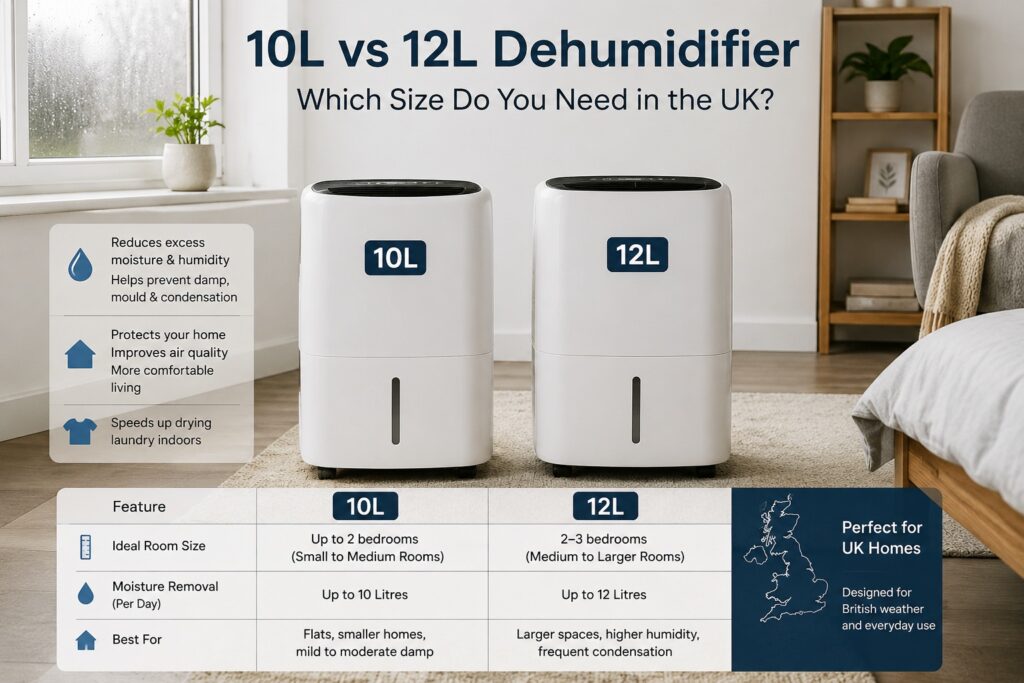
Choosing between a 10L and 12L dehumidifier can be confusing because the difference may look small at first. Both sizes are popular for UK homes, especially where condensation, damp patches, musty smells or indoor laundry are part of everyday life. However, the better choice depends on the room size, moisture level, how often you plan to use the unit and whether the problem is occasional condensation or a more persistent humidity issue.
A 10L dehumidifier is often suitable for smaller rooms, bedrooms, flats and mild to moderate moisture problems. A 12L dehumidifier can give extra capacity for slightly larger spaces, busier households or rooms where condensation appears more frequently. The right option is not always the biggest one, but the one that can control moisture effectively without wasting energy, space or money.
In this guide, we compare 10L and 12L dehumidifiers for UK homes, including room suitability, daily use, condensation control, running costs and practical buying decisions. By the end, you should have a clearer idea of whether a 10L model is enough or whether stepping up to 12L makes more sense for your home.
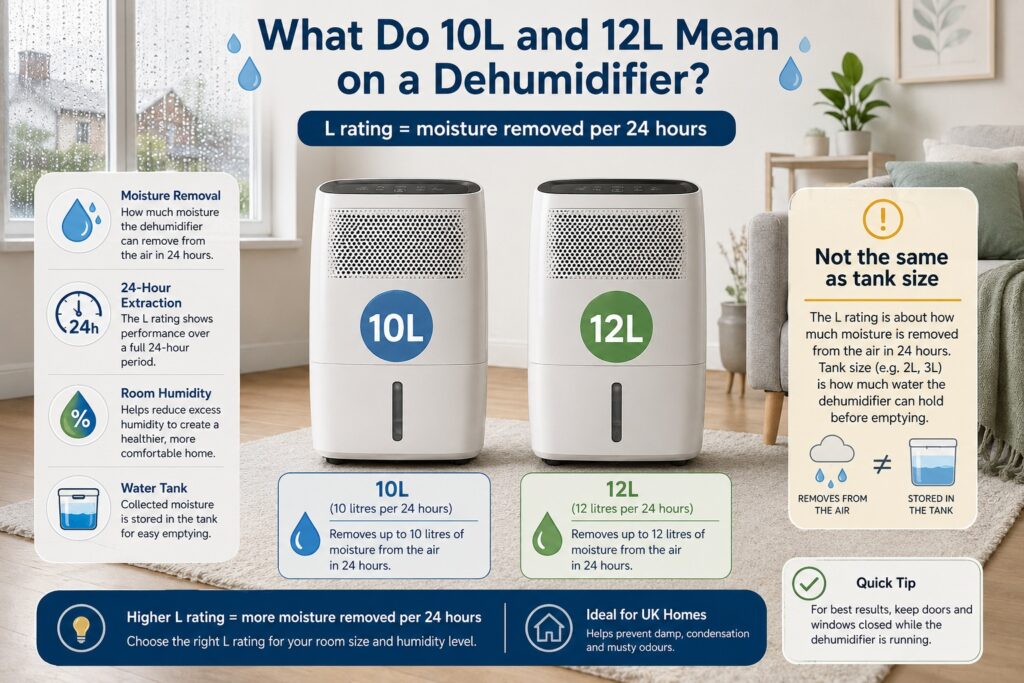
What Does 10L or 12L Mean on a Dehumidifier?
When a dehumidifier is described as 10L or 12L, this usually refers to the amount of moisture it can remove from the air over a 24-hour period under controlled test conditions. It does not necessarily mean that the water tank holds 10 or 12 litres. In many cases, the tank is smaller and needs emptying before the unit reaches its maximum daily extraction capacity.
This matters because real UK homes rarely match perfect test conditions. A dehumidifier may collect less water in a cooler bedroom than it would in a warm, humid test environment. Room temperature, humidity level, ventilation, laundry drying, condensation and how long the unit runs each day all affect the amount of moisture it removes.
A 10L model is usually aimed at smaller spaces and moderate moisture problems, while a 12L model gives slightly more extraction capacity for rooms where humidity builds up more often. The difference may not sound huge, but in everyday use it can matter if you are dealing with regular window condensation, a slightly larger room or more frequent indoor laundry.
The key point is simple: the litre rating helps you compare drying capacity, but it should not be the only factor you use when choosing. Room size, damp severity and daily use pattern are just as important.
When Is a 10L Dehumidifier Enough?
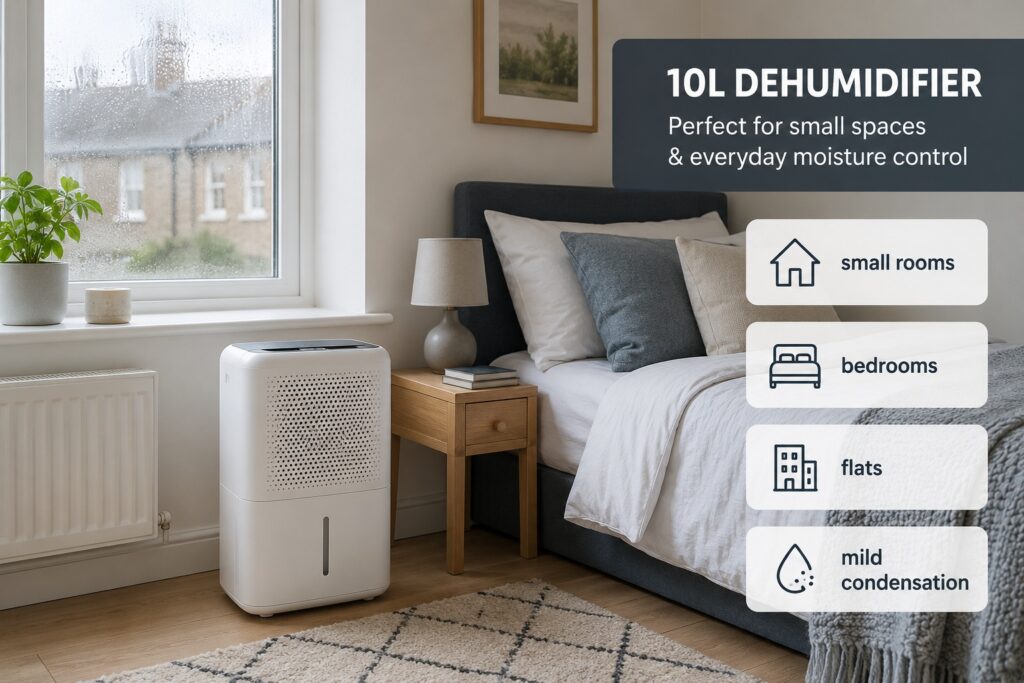
A 10L dehumidifier is often enough for smaller UK rooms where moisture is noticeable but not severe. It can be a practical choice for bedrooms, small living rooms, box rooms, flats, home offices and occasional damp problems where the main issue is light condensation, musty air or moisture from everyday activities.
This size usually makes sense when you want regular moisture control without buying a larger unit than you need. If your room is not especially large, the humidity problem is moderate and you are mainly trying to reduce condensation on windows or improve comfort, a 10L model may offer a sensible balance between performance, size and running cost.
A 10L dehumidifier can also be easier to live with in smaller spaces. It is usually more compact than larger models, simpler to move between rooms and less intrusive in bedrooms or flats where floor space matters. For users comparing compact options, our 10L dehumidifier guide explains where this size can work well and what limitations to consider.
However, a 10L model may not be enough if the room is large, the damp problem is persistent or you regularly dry laundry indoors. In those cases, the unit may need to run for longer to keep up with moisture, and stepping up to a 12L model may be more practical.
When Is a 12L Dehumidifier the Better Choice?
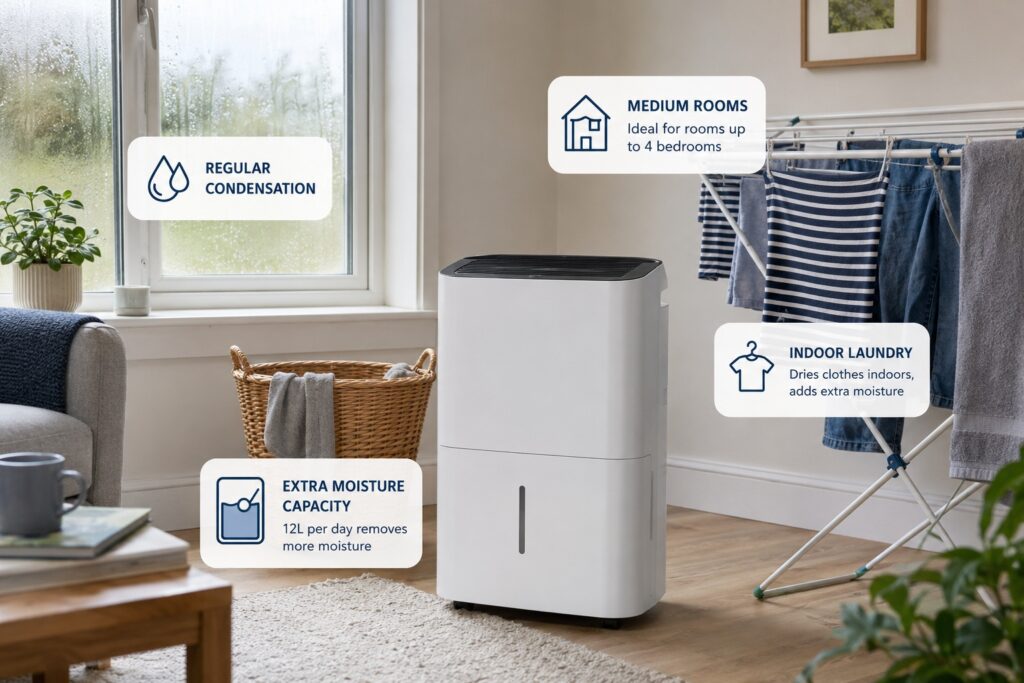
A 12L dehumidifier can be the better choice when you need slightly more moisture removal than a compact 10L model can comfortably provide. This size is often useful in medium-sized rooms, busier households, colder homes with regular condensation or spaces where humidity builds up quickly after showering, cooking or drying laundry indoors.
The extra capacity does not mean a 12L dehumidifier is automatically the right choice for every home. It simply gives more headroom. If your windows are wet most mornings, your room feels damp for long periods or a smaller unit would need to run almost constantly, stepping up to 12L may help control moisture more effectively.
A 12L model may also make sense if you want one unit to cover more than one room at different times. While a dehumidifier works best in an enclosed space, a slightly larger model can be more flexible if you plan to move it between a bedroom, hallway, utility area or small living room. For example, a model such as the Devola 12L dehumidifier is the type of option people may compare when they want more capacity than a compact 10L unit without moving into much larger household dehumidifiers.
The main trade-off is size, noise, price and energy use. A 12L dehumidifier may cost more to buy and may be less compact than a smaller model, so it should be chosen because your moisture problem genuinely needs the extra capacity, not simply because it looks like a safer option.
10L vs 12L Dehumidifier by Room Type
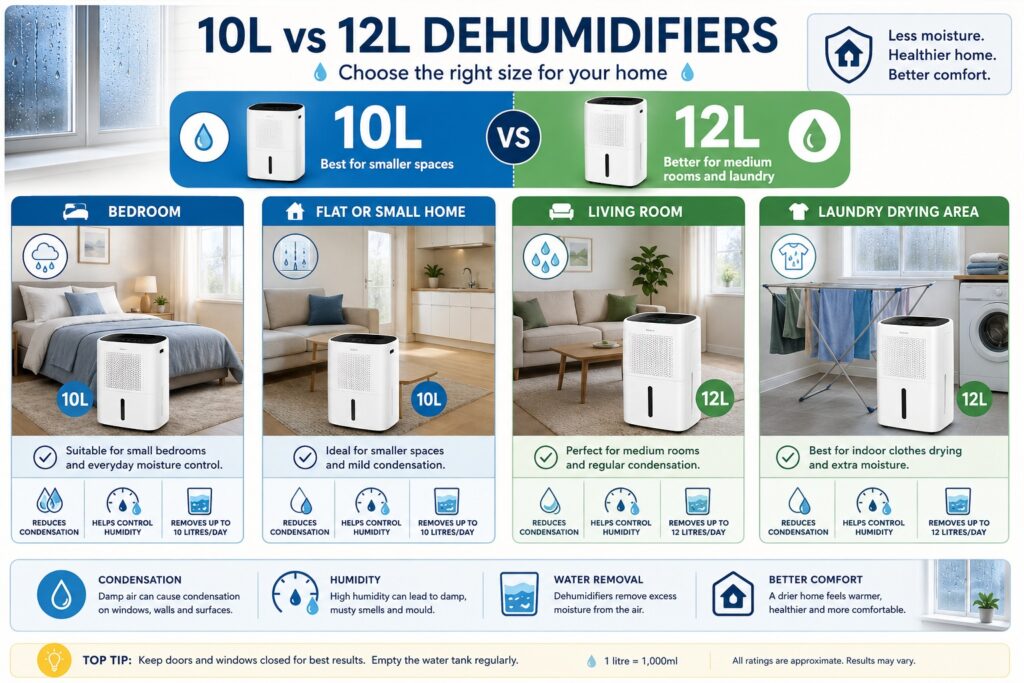
The best dehumidifier size depends heavily on where you plan to use it. A 10L and 12L model can look similar on paper, but the right choice changes depending on the room size, ventilation, temperature and how much moisture is being produced each day.
Bedrooms and Small Rooms
For bedrooms, box rooms and small home offices, a 10L dehumidifier is often enough if the main problem is light window condensation, musty air or occasional dampness. These rooms usually do not need a large-capacity unit unless the moisture problem is severe or the space is poorly ventilated.
A smaller unit can also be easier to position in a bedroom, especially if floor space is limited. If you are comparing compact options for smaller spaces, our guide to the best 10L dehumidifiers for small rooms in the UK can help you understand which type of model may suit bedrooms, flats and smaller homes.
Flats and Smaller Homes
In many UK flats, a 10L dehumidifier can be a sensible starting point, especially if the property has moderate condensation rather than serious damp. Flats often suffer from moisture because of cooking, showering, drying clothes indoors and limited ventilation, but that does not always mean a larger unit is necessary.
However, if condensation appears across several windows, clothes take a long time to dry or the air feels damp most days, a 12L model may provide more useful headroom.
Living Rooms and Medium Spaces
For medium-sized living rooms, a 12L dehumidifier may be the better option, especially if the room is used heavily or connected to other moisture-producing areas. Larger rooms contain more air, so a smaller unit may need to work for longer to bring humidity down.
A 10L model can still work in a living room if the space is compact and the moisture problem is mild. But for regular condensation or a busier household, the extra capacity of a 12L unit may make day-to-day moisture control easier.
Laundry Drying Areas
If you regularly dry laundry indoors, a 12L dehumidifier is usually the stronger choice. Wet clothes release a lot of moisture into the air, and a slightly larger unit can help remove that moisture more effectively than a compact model.
A 10L dehumidifier can still help with occasional laundry drying in a small room, but it may take longer and may need to run more often. If indoor laundry is part of your weekly routine, choosing 12L can offer a more practical margin.
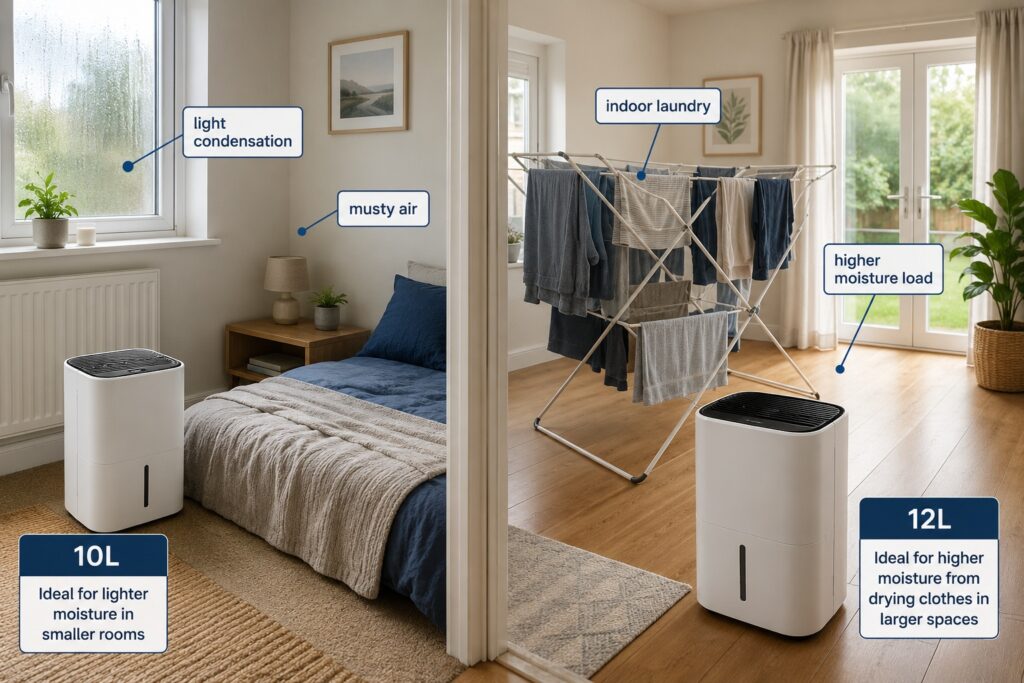
10L vs 12L Dehumidifier for Condensation, Damp and Laundry
The right size depends not only on the room, but also on how much moisture is being produced. A 10L dehumidifier may be enough for light condensation in one room, while a 12L model can be more suitable when moisture appears regularly or comes from several everyday sources.
Window Condensation
If you only get light condensation on bedroom windows in the morning, a 10L dehumidifier may be enough. It can help lower the humidity in smaller rooms and reduce the amount of moisture settling on cold glass overnight.
If condensation is heavy, appears on several windows or returns quickly after wiping, a 12L model may be more practical. The extra extraction capacity can help the dehumidifier keep up better, especially in colder UK homes where windows and external walls stay cooler for longer.
Mild Damp and Musty Smells
For mild dampness or a musty smell in a small room, a 10L dehumidifier can be a sensible first choice. It may help improve comfort, reduce excess moisture and make the room feel fresher when used regularly.
However, if the damp smell affects a larger space, returns quickly or is linked to poor ventilation, a 12L model may offer more useful capacity. A dehumidifier can help manage moisture in the air, but it should not be treated as a fix for structural damp, leaks or serious mould problems.
Indoor Laundry Drying
Indoor laundry is one of the biggest reasons to consider a 12L dehumidifier. Wet clothes release a lot of moisture into the air, and a smaller unit may need to run for longer to keep the room under control.
A 10L model can still help with occasional laundry drying in a small room, but a 12L unit is usually more practical if you dry clothes indoors several times a week. If condensation is your main problem, our guide to the best dehumidifier for condensation in the UK also explains what to consider when choosing a model for window moisture and damp air.
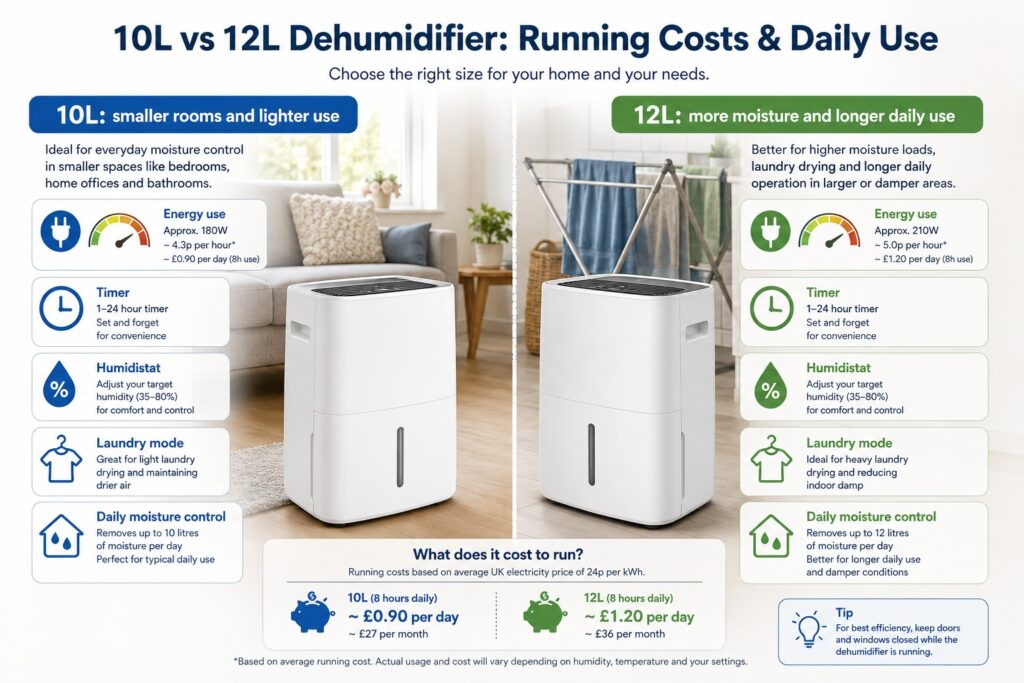
10L vs 12L Dehumidifier Running Costs and Daily Use
Running cost is one of the most important factors when choosing between a 10L and 12L dehumidifier. A smaller 10L model may use less power than a larger unit, but that does not automatically mean it will always be cheaper in real life. If a 10L dehumidifier has to run for much longer to control moisture, the difference in energy use may become smaller than expected.
A 12L dehumidifier may have slightly higher power demand, but it can also remove more moisture in suitable conditions. In a room with regular condensation or indoor laundry, the extra capacity may help the unit reach the target humidity more efficiently. The best choice depends on how hard the dehumidifier needs to work, not just the size printed on the product page.
For mild moisture in a small room, a 10L dehumidifier is usually the more sensible choice because it gives enough performance without unnecessary size or cost. For heavier daily moisture, a 12L model may be more practical because it gives more headroom and may avoid the frustration of a smaller unit running constantly.
To keep running costs under control, look for a model with a humidistat, laundry mode, timer, auto shut-off and clear humidity settings. These features help the dehumidifier run only when needed rather than wasting energy.For a wider look at efficiency across different capacities, our energy efficient dehumidifier size guide compares mini, 10L, 12L and 20L models to show which size may suit different UK rooms and running patterns.
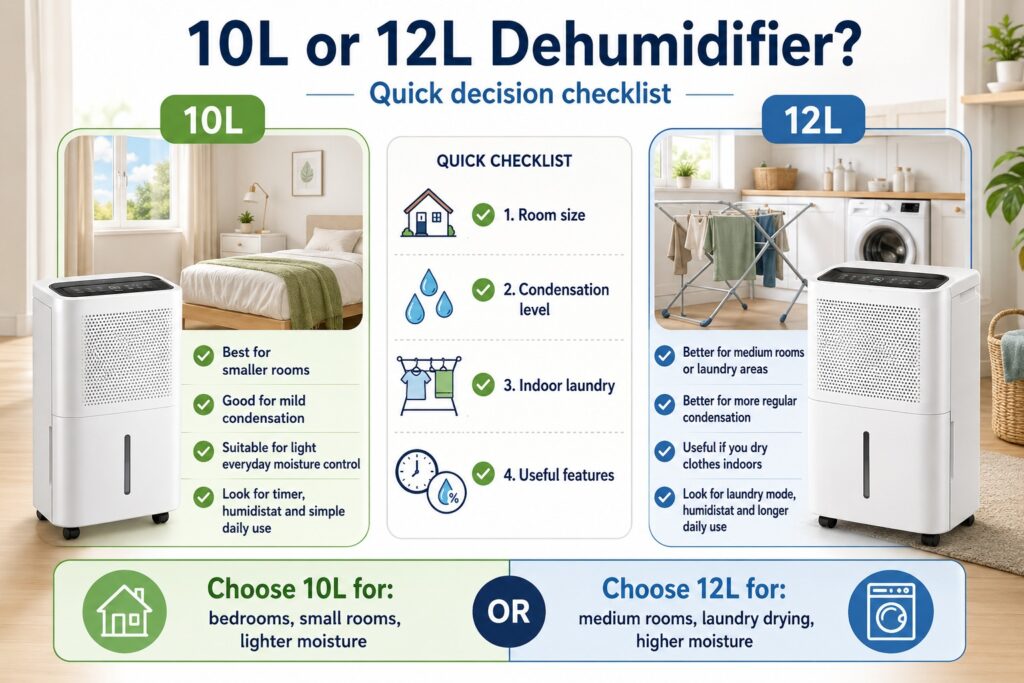
How to Choose Between a 10L and 12L Dehumidifier
Choosing between a 10L and 12L dehumidifier is easiest when you look at your real home conditions rather than the numbers alone. The better option depends on the room, how often moisture appears and whether the unit will be used occasionally or as part of your daily routine.
Start with the Room Size
For a small bedroom, home office, box room or compact flat, a 10L dehumidifier is often enough. It can help manage lighter moisture problems without taking up too much space or costing more than necessary.
For medium rooms, busier living spaces or areas where humidity builds quickly, a 12L model may be the safer choice. The extra capacity can give the unit more headroom, especially if you want it to work efficiently without running constantly.
Look at How Often Condensation Appears
If condensation appears only occasionally or mostly on colder mornings, a 10L model may be suitable. If windows are wet most days, water gathers heavily on glass or condensation returns soon after wiping, a 12L dehumidifier may be more practical.
Frequent condensation is usually a sign that more moisture is being produced than the room can naturally release. In that situation, choosing a slightly stronger model can make daily moisture control easier.
Think About Indoor Laundry
If you rarely dry clothes indoors, a 10L dehumidifier may be enough for general room moisture. If you dry laundry inside several times per week, a 12L model is usually more suitable because wet clothes release a large amount of moisture into the air.
Laundry drying is one of the clearest reasons to choose extra capacity, especially in flats, winter months or homes where ventilation is limited.
Check Features, Not Just Capacity
A good dehumidifier should be easy to control. Look for features such as a humidistat, timer, laundry mode, auto shut-off, continuous drainage option and clear humidity display. These features can matter as much as the litre rating because they affect how convenient and efficient the unit is in daily use.
If you are still unsure which type, size or feature set suits your home, our guide on how to choose the right dehumidifier in the UK explains the wider buying factors before choosing a specific model.
Common Mistakes When Choosing Between 10L and 12L Dehumidifiers
Choosing between a 10L and 12L dehumidifier should be based on how your home actually behaves, not only on the number printed on the product page. Many buyers choose the wrong size because they focus on capacity alone and ignore room conditions, moisture sources and daily use.
Assuming 12L Is Always Better
A 12L dehumidifier gives extra moisture removal capacity, but that does not mean it is always the better choice. In a small bedroom or compact flat with mild condensation, a 10L model may be enough and may be easier to position, store and use.
Buying a larger unit than you need can mean paying more upfront and using a device that takes up more space without giving much practical benefit. The best size is the one that matches the room and moisture level.
Choosing 10L When the Moisture Problem Is Too Heavy
The opposite mistake is choosing a 10L dehumidifier for a room that produces too much moisture. If you dry laundry indoors several times a week, have heavy window condensation or need one unit to work across larger spaces, a 10L model may struggle to keep up.
In that situation, the smaller unit may run for longer, fill more often and still feel less effective. A 12L dehumidifier can be more practical when the moisture load is higher and regular control is needed.
Confusing Extraction Capacity with Tank Size
The 10L or 12L rating usually refers to daily extraction capacity in test conditions, not necessarily the water tank size. Many dehumidifiers have much smaller tanks, so they may need emptying before reaching their maximum daily extraction figure.
This is why tank size, auto shut-off and continuous drainage options are worth checking. A model may have good extraction capacity, but if the tank is small and you use it heavily, frequent emptying can become annoying.
Ignoring Room Temperature
Room temperature affects how well many dehumidifiers perform. In cooler UK bedrooms, hallways or utility spaces, a dehumidifier may collect less water than expected compared with warmer test conditions. This does not always mean the unit is faulty; it may simply be working in less favourable conditions.
If your home is cold, poorly ventilated or affected by regular winter condensation, the right size and features become more important. A humidistat, laundry mode and sensible placement can make a noticeable difference in daily use.
Treating a Dehumidifier as a Fix for Serious Damp
A dehumidifier can help manage moisture in the air, but it cannot repair leaks, penetrating damp, rising damp or structural ventilation problems. If there is staining, crumbling plaster, water ingress or mould returning quickly despite regular dehumidifier use, the underlying cause should be investigated.
For everyday condensation and humidity, choosing the right 10L or 12L model can help. For serious damp, the dehumidifier may only reduce symptoms while the real problem remains.
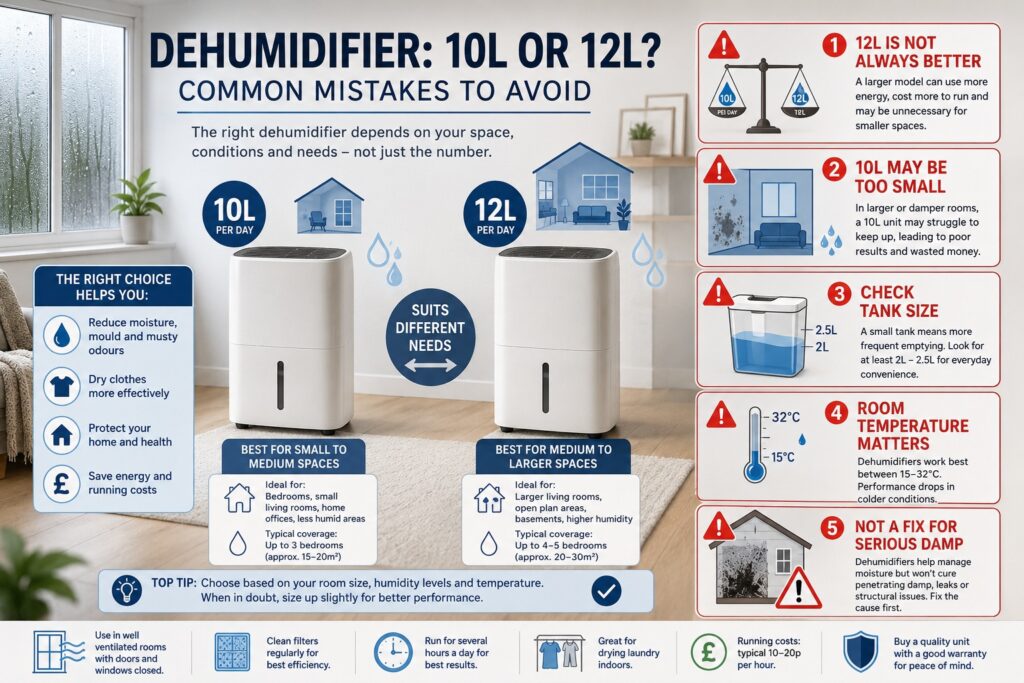
10L vs 12L Dehumidifier: Quick Buying Verdict
A 10L dehumidifier is usually the better choice if you need moisture control in a smaller room, bedroom, compact flat or home office. It makes sense when condensation is mild to moderate, the room is not too large and you want a unit that is easier to move, store and use every day without buying more capacity than you need.
A 12L dehumidifier is usually the better choice if the room is slightly larger, condensation appears more often or you regularly dry laundry indoors. The extra capacity can give more breathing room, especially in colder UK homes where moisture builds quickly and ventilation is limited during winter.
The most important point is that neither size is automatically better. A 10L model can be the smarter option for small spaces and lighter moisture, while a 12L model can be more practical for busier homes, medium rooms and regular condensation. If your damp problem is severe, affects several rooms or keeps returning despite regular use, you may need a larger dehumidifier or to investigate the underlying cause of moisture.
If you feel that a 12L model may still not be enough for your home, our 12L vs 20L dehumidifier guide explains when stepping up to a larger unit makes sense for bigger rooms, frequent condensation and indoor laundry drying.
For most UK households choosing between these two sizes, the decision is simple: choose 10L for smaller rooms and lighter daily moisture, and choose 12L when you want extra capacity for more frequent condensation, laundry drying or a slightly larger space.
Frequently Asked Questions About 10L and 12L Dehumidifiers
Is a 10L dehumidifier enough for a bedroom?
A 10L dehumidifier is often enough for a bedroom if the room is small to medium-sized and the moisture problem is mild to moderate. It can help reduce morning window condensation, musty air and everyday humidity when used regularly. However, if the bedroom is large, poorly ventilated or affected by heavy condensation every day, a 12L model may be more practical. The best choice depends on the room size, how cold the room gets and how quickly moisture builds up overnight.
Is a 12L dehumidifier better than a 10L model?
A 12L dehumidifier is not automatically better than a 10L model. It simply offers more moisture removal capacity, which can be useful in medium rooms, busier households or spaces with regular condensation. For a small bedroom, flat or home office with lighter moisture, a 10L model may be enough and could be easier to store and move. A 12L unit is usually worth considering when the moisture problem is more frequent or when indoor laundry adds extra humidity.
Which size is better for condensation on windows?
For light condensation on one or two windows, a 10L dehumidifier may be enough, especially in a smaller room. If condensation appears heavily every morning, affects several windows or returns quickly after wiping, a 12L dehumidifier may be a better option. The extra capacity can help manage more moisture in the air, particularly in colder UK homes where window surfaces stay cool. Placement, ventilation and consistent use also affect how well either size performs.
Is a 10L or 12L dehumidifier better for drying clothes indoors?
A 12L dehumidifier is usually the better choice for regular indoor laundry drying because wet clothes release a lot of moisture into the air. The extra capacity can help remove moisture more effectively, especially in winter or in homes with limited ventilation. A 10L dehumidifier can still help with occasional laundry drying in a small room, but it may need to run for longer. If you dry clothes indoors several times a week, 12L is usually the more practical size.
Does a 12L dehumidifier cost more to run than a 10L one?
A 12L dehumidifier may use more power than a smaller 10L model, but running cost depends on how long the unit operates and how efficiently it controls moisture. If a 10L model has to run for many hours to keep up with humidity, the energy difference may be smaller than expected. A 12L unit can sometimes manage heavier moisture more effectively, but it should only be chosen when the room or moisture level justifies the extra capacity. Features such as a humidistat, timer and laundry mode can help reduce unnecessary running time.
Should I buy a 10L, 12L or larger dehumidifier?
Choose a 10L dehumidifier for smaller rooms, bedrooms, flats and mild to moderate condensation. Choose a 12L dehumidifier for medium rooms, more frequent window condensation, busier households or regular indoor laundry drying. If the damp problem affects several rooms, the property feels humid most of the time or moisture returns quickly despite regular use, a larger model may be needed. Serious damp, leaks or mould that keeps returning should also be investigated rather than relying only on a dehumidifier.
Final Verdict: Should You Choose a 10L or 12L Dehumidifier?
A 10L dehumidifier is usually the better choice for smaller UK rooms, bedrooms, flats and lighter condensation problems. It can be practical, compact and easier to use every day when the moisture issue is moderate and limited to one main space.
A 12L dehumidifier is usually the better choice when you need extra capacity for more regular condensation, medium rooms, indoor laundry or busier households. The extra moisture removal can give more flexibility, especially in homes where humidity builds up quickly during colder months.
The best choice is not simply the bigger model. It depends on room size, moisture level, ventilation, indoor laundry habits and how often the unit will run. For most homes, 10L is enough for smaller spaces and mild to moderate moisture, while 12L is the safer option when condensation is more frequent or the room needs stronger daily humidity control.
If your damp problem is severe, spreads across several rooms or keeps returning despite regular dehumidifier use, the issue may need more than a 10L or 12L unit. In that case, it is worth checking for leaks, poor ventilation or structural damp before relying only on a dehumidifier.